


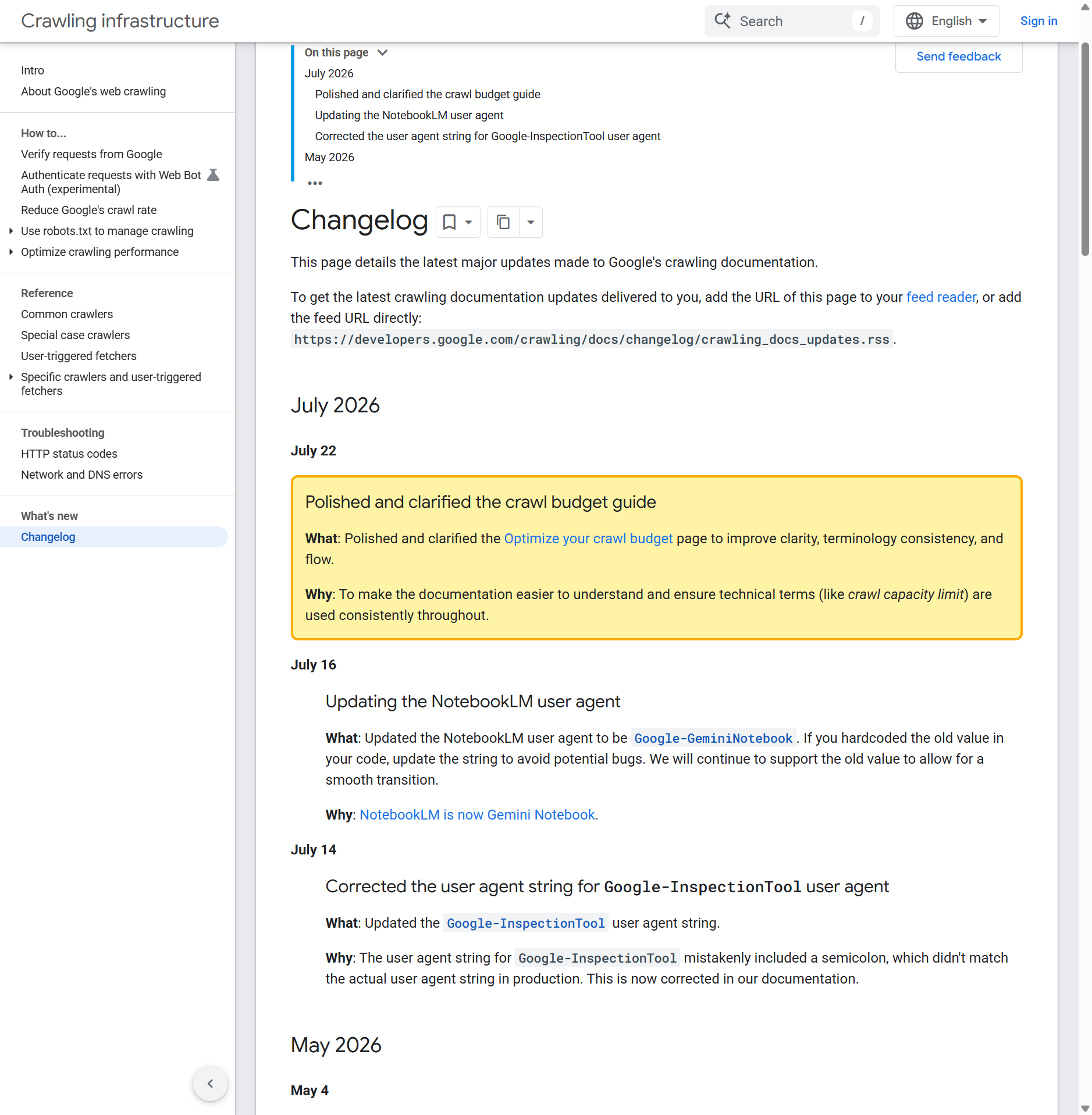
Fact-check verdict: Google did rewrite its crawl-budget documentation on July 22, 2026, and several additions are genuinely useful. But this was not a Google ranking update, not a new penalty, and not evidence that every small website suddenly needs a crawl-budget project. Google’s own changelog describes the work as a clarification intended to improve terminology and flow.
The most important new statements are that every site begins with the same conservative crawl capacity limit, that Google can adjust that limit when demand exists and the host stays healthy, and that the capacity limit is shared across Google’s crawlers. The revised guide also names latency, Time to First Byte (TTFB), 5xx responses, 429 rate limits, and 304 Not Modified caching more explicitly.
Other claims circulating on LinkedIn are true but not new. Google had already said that Googlebot’s demand varies with site size, update frequency, page quality, and relevance. It had also documented that faster, healthier servers can support more crawling. After comparing Google’s live page with an archived copy from July 21, this is the practical conclusion: the documentation became more precise; Google did not announce that its underlying crawling or ranking systems changed on July 22.
| Claim from the discussion | Verdict | What the evidence actually says |
|---|---|---|
| Google significantly updated its crawl-budget documentation. | Mostly true | The page received a meaningful rewrite and new explicit statements, but Google labels it a clarification rather than a system or algorithm change. |
| Every new website starts with a conservative crawl budget. | True with corrected terminology | Google says every site starts with the same conservative crawl capacity limit. Capacity is only one half of crawl budget; crawl demand is the other. |
| Demand depends on size, freshness, quality, and relevance. | True, but not new | This substance was present in the pre-update version. The new wording separates Googlebot demand from AdsBot and Shopping examples more clearly. |
| One Google crawler can reduce capacity available to another. | New explicit clarification | The live guide says crawlers have different demand but share the host’s crawl capacity limit. It does not provide a fixed daily quota or a crawler-by-crawler allocation formula. |
| Site speed matters for crawl budget. | True, but not new | The revised guide is more specific about response stability, latency, TTFB, 5xx, 429, rendering efficiency, and HTTP caching. |
| More crawling means better rankings. | False | Crawling is required before a URL can be evaluated for indexing, but Google says crawl rate is not a ranking signal. |
The primary-source trail
This analysis uses four layers of evidence: the current Google crawl-budget guide, Google’s official crawling-documentation changelog, an archived July 21 pre-update copy, and supporting Google documentation on crawling myths, crawl troubleshooting, and the Search Console Crawl Stats report.
What crawl budget actually means
Crawl budget is not simply “the number of pages Google crawls per day.” Google defines it through two interacting controls:
- Crawl capacity limit: how much crawling the host can safely support without being overwhelmed. Google also calls this hostload.
- Crawl demand: how much Google wants to crawl based on the needs of a particular crawler and, for Googlebot, factors such as inventory, popularity, staleness, site size, update frequency, quality, and relevance.
A site can therefore be under-crawled for two very different reasons. Google may want to crawl more but back off because the server is slow or failing. Or the server may have ample headroom while Google sees little demand to revisit the URLs. Buying a larger server addresses the first condition, not the second. Publishing useful, unique, well-linked content can affect demand, but it does not create a guaranteed crawl entitlement.
The unit also matters: Google describes a site here as a unique hostname. www.example.com and shop.example.com can therefore have separate crawl budgets. Moving images, scripts, APIs, or storefronts to another hostname changes what appears in a given host’s crawl data; it does not make the requests disappear from the web.
What changed on July 22, 2026
1. Google documented a common conservative starting capacity
The clearest new sentence says every site begins with the same conservative crawl capacity limit. Google can adjust it over time if two conditions hold: there is demand to crawl more and the site stays healthy.
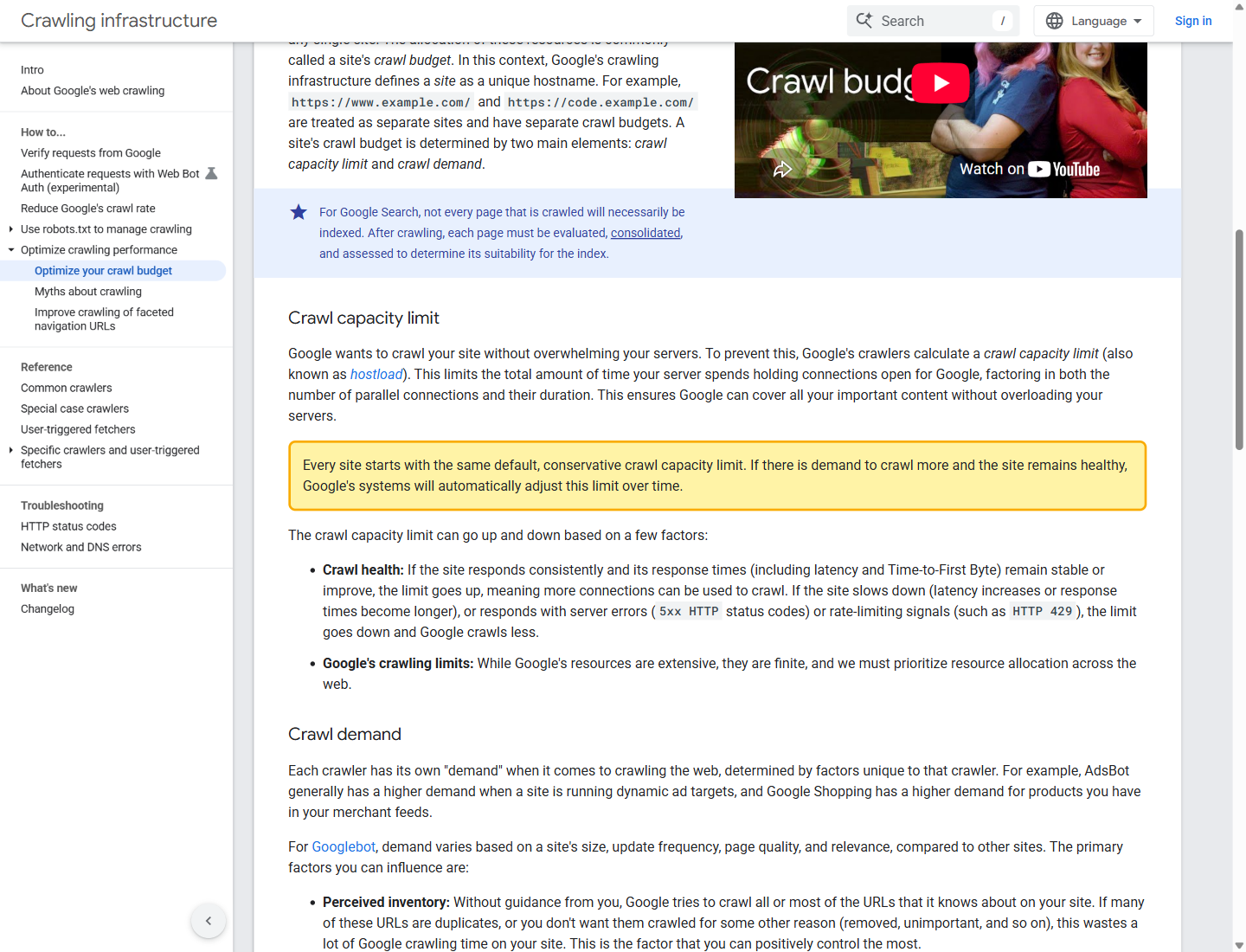
This does not mean that established and new sites keep identical crawl limits forever. “Starts with the same default” describes initialization. Google immediately adds that the limit can change. Nor does it mean a new site is placed in an SEO probation period. The document describes resource allocation, not a trust sandbox or ranking penalty.
2. Host health is now described more precisely
The older guide said the limit could rise when a site responded quickly and fall when the site slowed or returned server errors. The new wording names the operational signals more clearly: stable or improving latency and TTFB can support more connections, while longer responses, 5xx errors, and 429 Too Many Requests responses cause Google to crawl less.
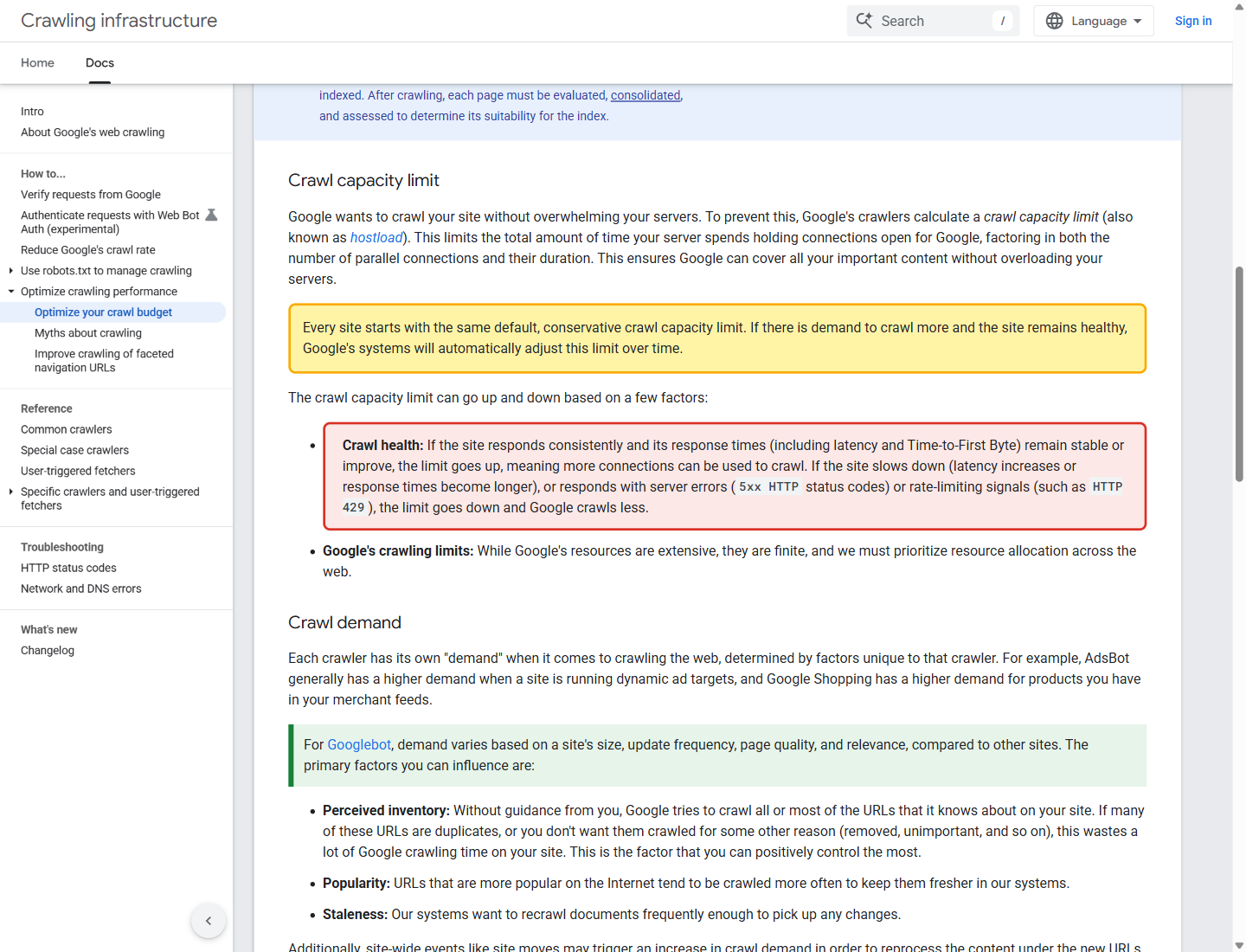
5xx, and 429. Highlight added by DMT. Source: Google for Developers; captured July 24, 2026, CC BY 4.0.The SEO implication is narrower than “Core Web Vitals increase crawl budget.” Google is talking primarily about the crawler’s ability to fetch and render resources without overloading the host. A fast Largest Contentful Paint score in a lab test is not the same metric as stable origin response time to Googlebot. Teams should examine Search Console, CDN/origin telemetry, and verified Googlebot logs rather than reducing the diagnosis to one PageSpeed score.
3. Google made shared crawler capacity explicit
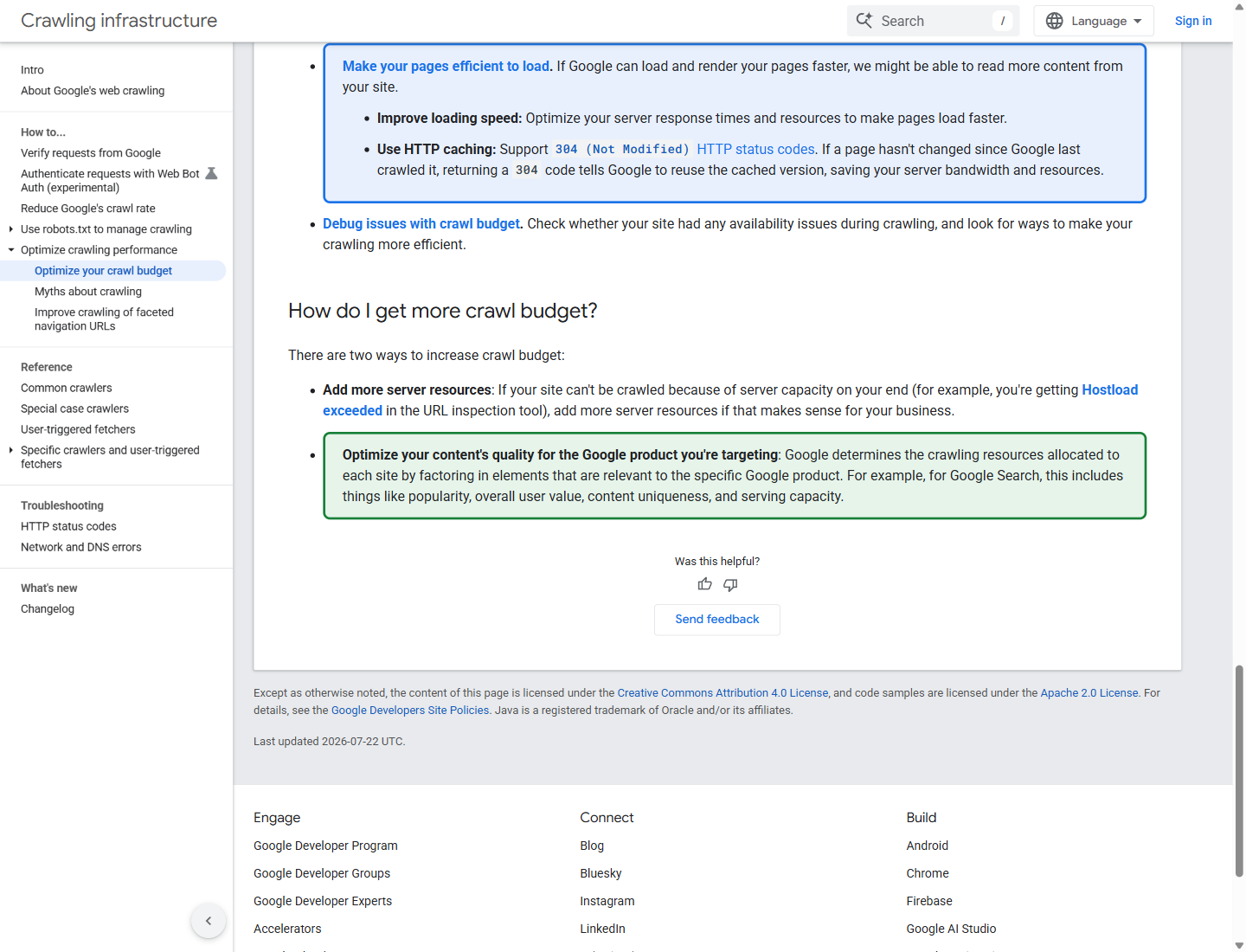
The most operationally interesting addition says different Google crawlers have their own demand but share the crawl capacity limit for the host. Google gives examples of AdsBot demand increasing for dynamic ad targets and Shopping demand increasing for products in merchant feeds. The practical concern is cross-team: SEO, paid media, product feeds, images, and infrastructure can no longer be treated as completely separate consumers of host capacity.
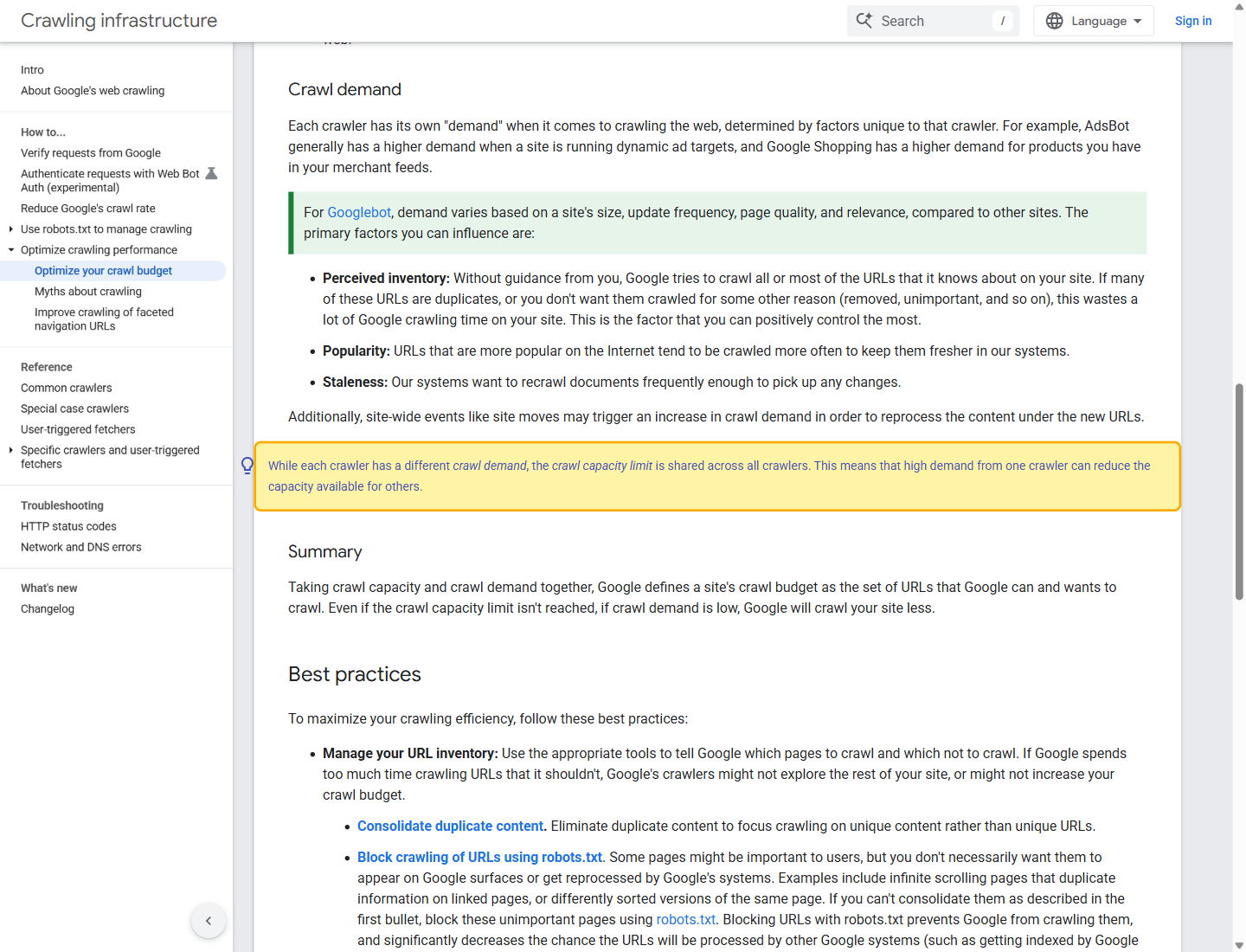
Do not overread this sentence. Google does not disclose a fixed pool size, a daily crawler quota, or a formula showing that one image request always replaces one HTML request. It also does not say that third-party bots such as GPTBot, ClaudeBot, Bingbot, or PerplexityBot share Google’s capacity system. The statement is about Google’s crawling infrastructure for a host.
4. HTTP caching became a prominent best practice
Google now explicitly recommends supporting 304 Not Modified. When a crawler sends an appropriate conditional request and the resource has not changed, a correct 304 lets Google reuse its cached copy without downloading the response body again. This saves bandwidth and server work and can indirectly improve crawl efficiency.
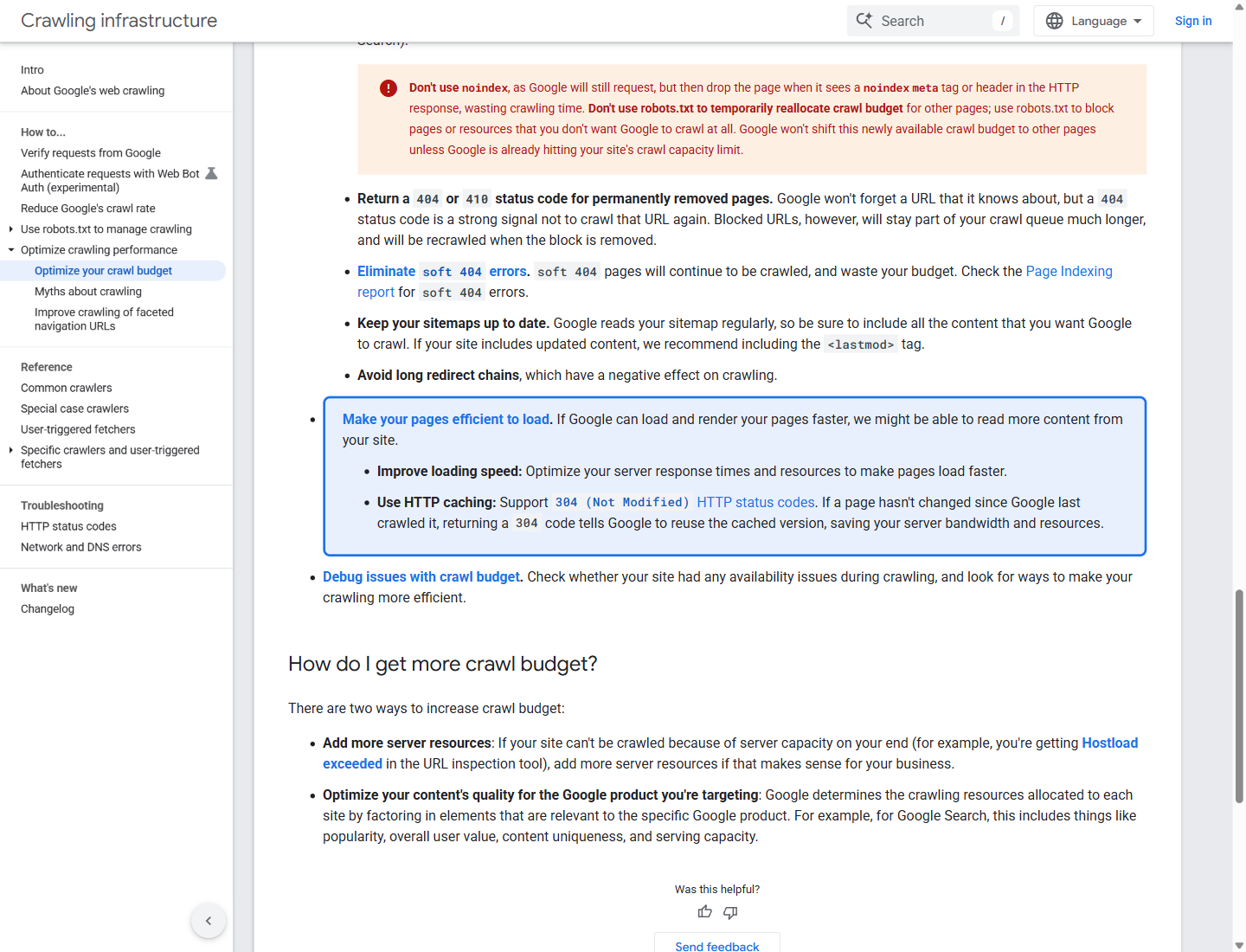
304 Not Modified caching. Highlight added by DMT. Source: Google for Developers; captured July 24, 2026, CC BY 4.0.Implementation still requires care. Conditional requests depend on correct validators such as ETag or Last-Modified, accurate cache behavior, and consistent content delivery. A mistaken 304 for changed content can leave Google with a stale representation. Test the response headers at the CDN and origin instead of enabling a rule blindly.
5. Terminology and report names were cleaned up
The rewrite consistently uses “crawl capacity limit,” adds the hostload label, replaces older “Index Coverage” wording with “Page Indexing,” and clarifies that finite Google resources have to be prioritized across the web. These changes make the document easier to apply, but they are documentation maintenance rather than evidence of a July 22 crawl algorithm release.
What did not change
- Crawl budget still combines capacity and demand. Google has used this two-part model since at least its 2017 explanation.
- Quality and relevance were already demand considerations. The pre-update copy already named site size, update frequency, page quality, and relevance.
- Popularity and staleness still affect demand. Popular URLs tend to be revisited more often, and Google tries to prevent indexed documents from becoming stale.
- Site moves can temporarily increase demand. Google may need to process redirects and new URLs across the migration.
- Speed and server errors already influenced crawl rate. The new page adds precision rather than inventing the relationship.
- Crawling is not a ranking signal. More crawl activity does not guarantee better positions.
This distinction matters for reporting. A traffic decline that begins near July 22 should not be labelled “the crawl-budget update” without crawl, indexing, ranking, and site-change evidence. DMT’s Google algorithm updates log explains how to separate documented ranking events from ordinary volatility, technical failures, and unrelated changes.
Who should actually care about crawl budget?
Google says this advanced guide is primarily for:
- large sites with roughly one million or more unique pages that change moderately often;
- sites with roughly 10,000 or more unique pages that change very rapidly, such as daily;
- sites with a large share of URLs reported as Discovered – currently not indexed.
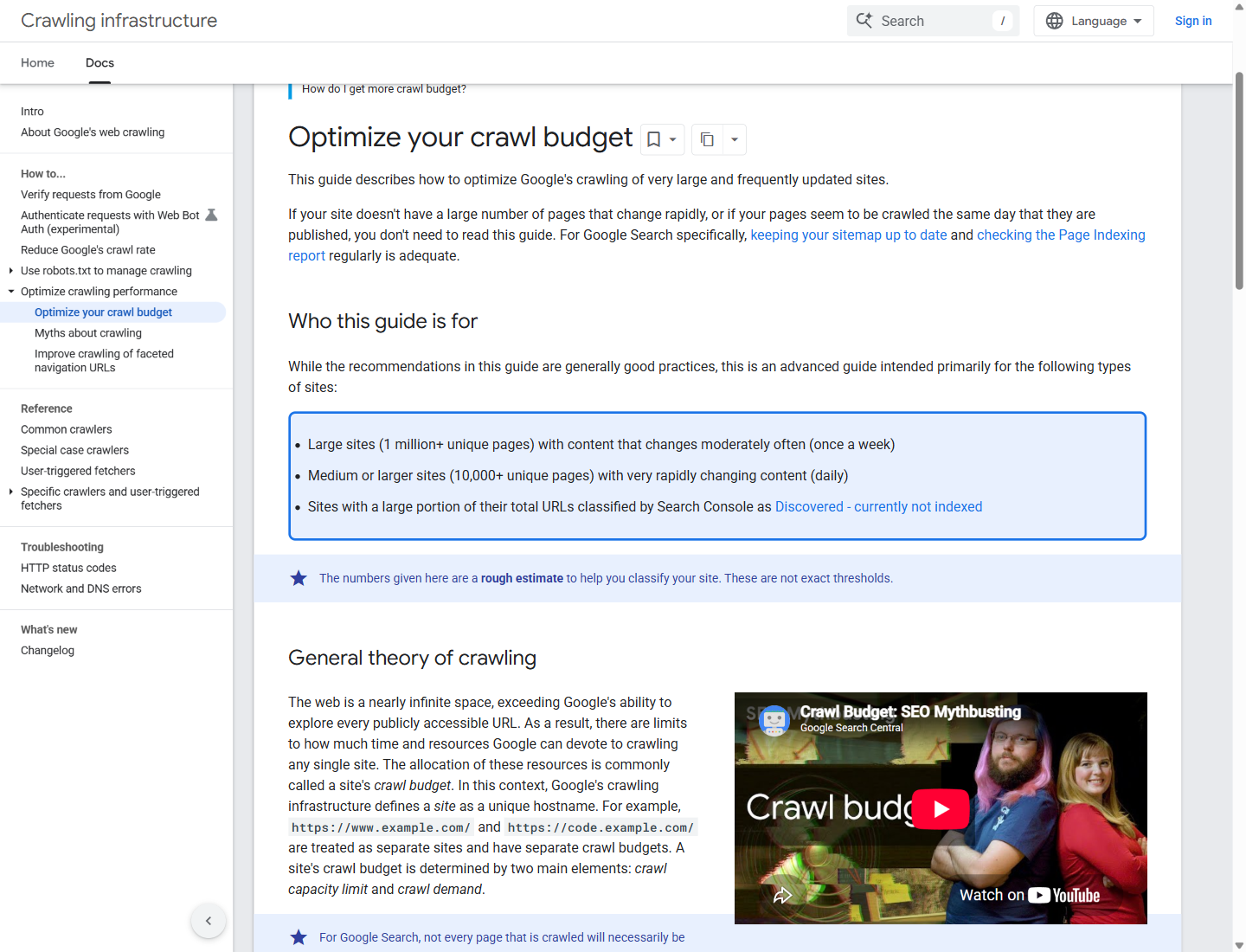
Google describes those numbers as rough classifications, not pass/fail thresholds. A smaller news site with constant publishing, a marketplace with faceted URL explosions, or a compromised site generating millions of junk URLs can still have a genuine crawl-efficiency problem. Conversely, a million-page site with stable architecture, healthy servers, and predictable updates may not be in crisis.
How the update affects different SEO teams
| Site or team | Why the clarification matters | First check |
|---|---|---|
| Ecommerce and marketplaces | Facets, sort parameters, internal search, product variants, expired inventory, images, AdsBot, and Shopping activity can create a large crawl space. | Compare valuable canonical inventory with parameter URLs and Googlebot/StoreBot/AdsBot activity in logs. |
| Programmatic SEO | Publishing database combinations faster than Google sees distinct value can raise inventory without raising demand. | Measure unique demand, indexation, internal-link depth, and quality by template cohort before scaling. |
| Publishers and news sites | Discovery and refresh speed matter for time-sensitive URLs, while archive and tag pages can expand inventory. | Validate news/general sitemaps, accurate lastmod, discovery latency, and server headroom during peaks. |
| International sites | Locale duplication, faceted combinations, alternate URLs, and separate hosts can complicate capacity and discovery. | Review host boundaries, canonicals, hreflang clusters, redirect chains, and crawl data per hostname. |
| JavaScript-heavy applications | Retrieving and rendering both consume resources; slow APIs and large asset graphs can delay useful processing. | Check server-rendered main content, resource responses, render failures, and whether essential links are crawlable HTML anchors. |
| Paid media and feed teams | Google now explicitly connects AdsBot and Shopping demand to the same host-capacity discussion. | Coordinate dynamic ad targets, product-feed changes, release calendars, and origin capacity with SEO and engineering. |
| Small brochure or local sites | The general technical practices remain useful, but crawl-budget optimization is usually not the bottleneck. | Start with indexability, sitemaps, internal links, content value, canonicals, and Page Indexing reasons. |
A diagnostic workflow before you claim “crawl budget problem”
Step 1: separate discovery, crawling, indexing, and ranking
- Discovery: does Google know the URL exists?
- Crawling: did a verified Google crawler request the URL and receive a usable response?
- Rendering and processing: could Google retrieve the required resources and understand the main content?
- Indexing: did Google select a canonical version and decide the page was suitable for the index?
- Ranking: is the indexed page relevant and competitive for a particular query?
A URL in Crawled – currently not indexed has already passed the crawl stage; throwing more crawl capacity at it may target the wrong bottleneck. A URL in Discovered – currently not indexed can indicate limited crawling, but Google also advises that insufficient value or user demand can affect whether a page appears in Search.
Step 2: inspect Search Console Crawl Stats
For eligible root-level properties, review total requests, total download size, average response time, host status, response-code mix, file types, crawl purpose, and Googlebot type. Search Console provides trends and examples, not a complete URL-level log. Treat a rise or fall in raw requests as context, not as success or failure by itself.
Step 3: use server or CDN logs for URL-level evidence
Verify Googlebot rather than trusting a user-agent string, then measure:
- which valuable URL cohorts are crawled and how often;
- discovery versus refresh activity;
- time from publishing or meaningful update to first crawl;
- requests spent on parameters, duplicate paths, redirects, soft errors, and nonessential resources;
- response-time percentiles and
5xx/429rates for verified Google traffic; - crawler type, host, response bytes, cache result, and origin versus edge behavior.
Step 4: compare Google’s perceived inventory with the inventory you want indexed
Map canonical, indexable, valuable URLs against everything discoverable through links, sitemaps, feeds, parameters, and legacy paths. The goal is not to make every URL crawlable. It is to make the intended inventory unambiguous and stop manufacturing endless low-value combinations. A structured SEO audit checklist helps keep crawling evidence connected to canonicalization, indexation, internal linking, performance, and content decisions.
Step 5: test one bottleneck at a time
Change a template cohort, parameter rule, caching policy, internal-link module, sitemap feed, or server configuration; record the release date; then compare crawl behavior, indexation, and organic performance against an unchanged cohort where practical. Otherwise a broad cleanup can create a pleasing crawl chart without showing which action helped.
How to improve crawl efficiency in the right order
1. Control URL inventory
- Consolidate duplicates with coherent canonicalization and internal links.
- Prevent faceted navigation, calendar paths, session IDs, internal search, and tracking parameters from creating infinite crawl spaces.
- Return
404or410for permanently removed URLs without replacements. - Fix soft 404s that keep returning crawlable
200responses for empty or missing content. - Remove avoidable redirect chains and update internal links to final destinations.
- Keep sitemaps limited to canonical URLs you actually want indexed and use accurate
lastmodvalues.
2. Improve server and rendering efficiency
- Stabilize origin and CDN response time, especially under crawl or traffic peaks.
- Investigate
5xx, timeouts, DNS failures, and unintended429responses. - Support conditional requests and correct
304responses for unchanged resources. - Reduce slow dependencies and rendering work required to expose main content and links.
- Make sure
robots.txtis consistently available; prolonged failures can slow or stop crawling.
3. Improve demand and priority signals
- Publish unique pages that solve distinct audience needs instead of thin permutations.
- Link important pages through crawlable, descriptive HTML links within a coherent architecture.
- Update content when the facts or user need changes, not to manufacture a fresh timestamp.
- Consolidate or improve overlapping pages based on evidence rather than mass-deleting content to “save budget.”
- Earn genuine popularity and references; Google says popular URLs tend to be crawled more often.
A documented SEO content strategy keeps this work tied to audience demand, page purpose, topic ownership, maintenance, and measurement. That is more durable than treating crawl budget as a one-off technical trick.
Internal linking is especially useful because it serves discovery, priority, context, and users at the same time. Use DMT’s internal-linking strategy guide to design links by reader journey and topic relationship rather than stuffing exact-match anchors into every page.
Crawl-budget myths the SEO community should retire
| Myth | Why it fails |
|---|---|
| “More Googlebot requests will improve rankings.” | Google says crawl rate is not a ranking signal. Crawling only makes later processing possible. |
| “Every indexing problem is a crawl-budget problem.” | Crawled-but-not-indexed, canonical selection, duplication, quality, policy, rendering, and demand can produce similar symptoms. |
| “Block any low-value URL in robots.txt and Google will spend the saved requests elsewhere.” | Google says reallocation is not guaranteed unless the host is already hitting its capacity limit. Robots blocking also prevents Google from seeing page-level directives. |
| “Use noindex to stop crawling.” | Google must crawl a page to discover its noindex. Use the directive for index control, not as a universal crawl throttle. |
| “Use crawl-delay in robots.txt.” | Google does not support the non-standard crawl-delay rule. |
| “Change the date or a few words so Google crawls the page more.” | Artificial freshness does not create additional value. Update when the content meaningfully changes. |
| “A faster site automatically earns a larger crawl budget.” | Speed can raise capacity, but low demand can still keep crawling low. |
| “Submitting a sitemap guarantees immediate crawling and indexing.” | Sitemaps help discovery and communicate updates; they are suggestions, not guarantees. |
What this means for the wider SEO community
The update’s biggest contribution is not a secret ranking lever. It is a better mental model for technical SEO.
- Capacity and demand must be diagnosed separately. Engineering fixes cannot manufacture search demand, and content improvements cannot compensate for an origin that repeatedly fails.
- Crawl management is cross-functional. SEO, paid search, feeds, media, platform engineering, and DevOps can influence the same host’s serving capacity and URL inventory.
- Programmatic scale needs an indexation thesis. Generating more URLs is not the same as creating more pages Google wants to revisit or index.
- Quality affects more than ranking discussions. Google explicitly includes overall user value and uniqueness in its explanation of crawl-resource allocation for Search.
- Technical SEO should become more evidence-led. Crawl Stats, verified bot logs, response codes, cache behavior, indexation cohorts, and controlled releases are stronger than generic “increase crawl budget” checklists.
- Small-site fear should decrease. Google again states that most sites do not need advanced crawl-budget management.
The update also strengthens the case for continuous content maintenance. A content audit should not ask only which posts gained or lost traffic. It should identify duplication, obsolete inventory, weak internal relationships, inaccurate freshness signals, and pages that consume crawling without serving a distinct reader need.
A practical crawl-efficiency scorecard
| Metric | Why it helps | Important caveat |
|---|---|---|
| Important URLs crawled within the required freshness window | Measures whether priority inventory is being discovered or refreshed in time. | The right window varies by news, product, price, policy, and evergreen content. |
| Discovery-to-first-crawl time | Shows how quickly new URLs enter Google’s fetching pipeline. | A crawl does not guarantee indexing. |
| Meaningful-update-to-recrawl time | Tests whether important changes are being revisited. | Use accurate change timestamps; trivial edits create noise. |
| Verified Googlebot response-time percentiles | Exposes slow cohorts that averages can hide. | Separate edge response from origin behavior and resource type. |
5xx, timeout, DNS, and unintended 429 rate | Measures host-health constraints that can reduce capacity. | A temporary maintenance event differs from a persistent pattern. |
| Requests to duplicate, parameter, redirect, soft-404, and nonessential URLs | Quantifies crawl-space waste. | Not every parameter or resource request is waste; classify by purpose. |
| Discovery versus refresh mix | Helps explain whether Google is finding new pages or revisiting known ones. | There is no universally correct ratio. |
| Indexation rate by template or cohort | Connects crawl evidence to indexing outcomes. | Exclude intentionally non-indexable URLs and separate discovery from quality problems. |
The bottom line
The LinkedIn post is directionally accurate, but the most responsible interpretation is narrower than the headline. Google published a substantial clarification of crawl-budget documentation. It newly states that all sites begin with the same conservative capacity limit and explicitly describes shared capacity across Google crawlers. It also gives practitioners better operational language for TTFB, server failures, rate limiting, caching, and content quality.
It did not announce a ranking update or a new small-site optimization requirement. Most of the underlying principles were already documented. The correct response is not to chase more bot requests. It is to make important URLs discoverable, keep the crawl space controlled, serve pages reliably, use caching correctly, publish content worth revisiting, and diagnose crawl evidence separately from indexing and ranking.
Frequently asked questions
Did Google change its crawl algorithm in July 2026?
Google documented a rewrite on July 22 but described it as a clarification for terminology, clarity, and flow. There is no official announcement that the underlying crawl or ranking algorithms changed because of this documentation update.
Is crawl budget a Google ranking factor?
No. Google says improving crawl rate does not necessarily improve search positions. Crawling is required before a page can be processed for indexing, but it is not a ranking signal.
Do small websites need to optimize crawl budget?
Usually not as a dedicated project. Small sites should still maintain crawlable links, accurate sitemaps, clean status codes, healthy servers, useful content, and correct indexation controls. If new or updated pages are already crawled promptly, Google says the advanced guide is unnecessary.
How can I increase Google crawl budget?
First determine whether the constraint is capacity or demand. Improve server resources and reliability when Google is hitting hostload limits. Improve inventory quality, uniqueness, internal discovery, popularity, and serving efficiency when demand is low. Blocking URLs does not guarantee that Google will transfer the saved requests elsewhere.
Does page speed affect crawl budget?
Stable, faster responses can let Google fetch more over available connections, while latency, 5xx, timeouts, and 429 responses can reduce crawling. This does not mean every Core Web Vitals improvement raises crawl demand or rankings.
Do Googlebot, AdsBot, and Shopping crawlers share crawl capacity?
Google’s revised guide says different crawlers have different demand while the crawl capacity limit is shared. It does not publish the allocation formula, and the statement should not be extended to non-Google crawlers.
Should I use robots.txt or noindex to save crawl budget?
Use each control for its intended purpose. Use robots.txt for resources or URL spaces you genuinely do not want crawled. Use noindex to keep crawlable pages out of the index. Google must crawl a page to see noindex, and newly blocked capacity is not automatically reassigned.
About the author and fact-check method
Digital Marketer Tayeeb publishes practitioner-focused analysis of SEO, digital marketing, and AI updates. This DMT article was fact-checked on July 24, 2026 using Google’s current guide and changelog, a July 21 archived copy, live browser inspection, Search Console help, and Google’s crawling myths and troubleshooting documentation. Screenshot highlights were added for readability; captions link to the original source.