


Claude Opus 5 is Anthropic’s new everyday frontier model: it keeps Opus 4.8’s base API price, costs half as much per token as Fable 5, and posts large gains over Opus 4.8 on Anthropic’s published capability evaluations. Externally run launch evaluations from ARC Prize and Artificial Analysis support important parts of that story. They do not prove that Opus 5 is more effective on every real production workload.
According to Anthropic’s official July 24 announcement and platform documentation, Opus 5 costs $5 per million input tokens and $25 per million output tokens, the same base rate as Opus 4.8. It has a one-million-token context window, up to 128,000 output tokens, adaptive thinking enabled by default, and five effort levels. Developers use the API alias claude-opus-5. Fast mode is an API research preview that Anthropic describes as roughly 2.5 times normal speed; it costs $10/$50 per million tokens and is not currently available through Amazon Bedrock, Google Cloud or Microsoft Foundry.
The launch evidence is broad, but every result needs an evaluator and setup label. Anthropic’s 194-page Opus 5 System Card reports gains in coding, computer use, knowledge work and scientific tasks. ARC Prize verified the ARC-AGI results, while Artificial Analysis ran GDPval-AA and AA-Briefcase using its own agent harness in coordination with Anthropic before release. Artificial Analysis also found a tradeoff the headline charts make easy to miss: high, xhigh and max Opus 5 averaged 25.7, 34.3 and 36.2 minutes per AA-Briefcase task. Early Reddit and X reactions are enthusiastic about coding quality but divided on usage limits and cost. Those posts are useful signals, not evidence of capability.
Claude Opus 5 at a glance
| Decision factor | Opus 5 | What it means |
|---|---|---|
| Base API price | $5 input / $25 output per million tokens | Same list price as Opus 4.8; half Fable 5’s base price |
| Fast mode | About 2.5× speed; $10 / $50 per million tokens | Buy latency only when waiting is more expensive than tokens |
| Context | 1M tokens, default and maximum | Large capacity, not guaranteed perfect recall |
| Maximum output | 128k tokens | Useful for code and artifacts; still set bounded deliverables |
| Thinking | Adaptive by default | Effort is the main quality/cost dial |
| Effort levels | low, medium, high, xhigh, max | Run your own effort sweep instead of defaulting every job to max |
| Best fit | Complex coding, review, research and enterprise agent work | Use Sonnet for routine volume; reserve Fable for the hardest justified cases |
What actually changed from Claude Opus 4.8?
Opus 5 is not just a renamed 4.8 endpoint. Anthropic describes the largest gains as deep reasoning, multi-file coding, long-horizon tool use, code review, vision, document work and coordination between subagents. The developer-facing changes matter just as much:
- Thinking now defaults on. An old Opus 4.8 request that omitted a thinking field can behave differently after changing the model ID.
- Effort has a wider, more consequential range. Low and medium can preserve useful quality while reducing latency and token use; xhigh and max are for jobs that demonstrate a measurable benefit.
- Context expands to one million tokens. This reduces forced chunking, but dumping an entire repository into one prompt is still poor context engineering.
- The prompt-cache minimum falls to 512 tokens. More modest reusable prompts can now qualify for caching.
- Mid-conversation tool changes and automatic fallbacks arrive in beta. These can improve long-running agent design, but beta behavior should be isolated and monitored.
- Default behavior is more proactive. Opus 5 tends to narrate more, verify its own work, widen scope and delegate more readily. Prompts must control these behaviors or pay for them.
If you currently use Opus 4.8, migrate through a test set rather than a blind model-ID replacement. Increase max_tokens where adaptive thinking may consume output budget, remove redundant “double-check everything” scaffolding, and test all effort levels on representative work. The earlier Claude Opus 4.7 guide provides useful family context, but Opus 5’s defaults require fresh evaluation.
Opus 5 vs Sonnet 5 vs Fable 5
| Model | API price per 1M input/output tokens | Best role | Main tradeoff |
|---|---|---|---|
| Claude Sonnet 5 | $2 / $10 through August 31, 2026; then $3 / $15 | High-volume coding, chat, classification and routine agents | Lowest cost in this comparison, but official evaluations show a gap on several hard agentic tasks |
| Claude Opus 5 | $5 / $25 | Difficult coding, review, research, analysis and complex agent workflows | Higher unit cost and potentially long runtimes at high effort |
| Claude Fable 5 | $10 / $50 | Highest-capability long-running agents where marginal quality has high value | Twice Opus 5’s base price, stricter safeguards on some tasks, and availability/credit considerations |
| Claude Opus 4.8 | $5 / $25 | Stable legacy baseline or fallback | Same list price as Opus 5 with weaker results across most rows in Anthropic’s Opus 5 summary table |
The practical routing rule is simple. Start with Sonnet 5 when the task is well specified, repeatable and easy to verify. Move to Opus 5 when errors are expensive, requirements are ambiguous, the codebase is large, or the work needs sustained judgment. Use Fable 5 only when a representative evaluation shows that its extra capability recovers more value than its doubled token price. DMT’s existing Fable 5 vs Sonnet 5 comparison covers the outer tiers in more detail.
What the benchmark claims do—and do not—prove
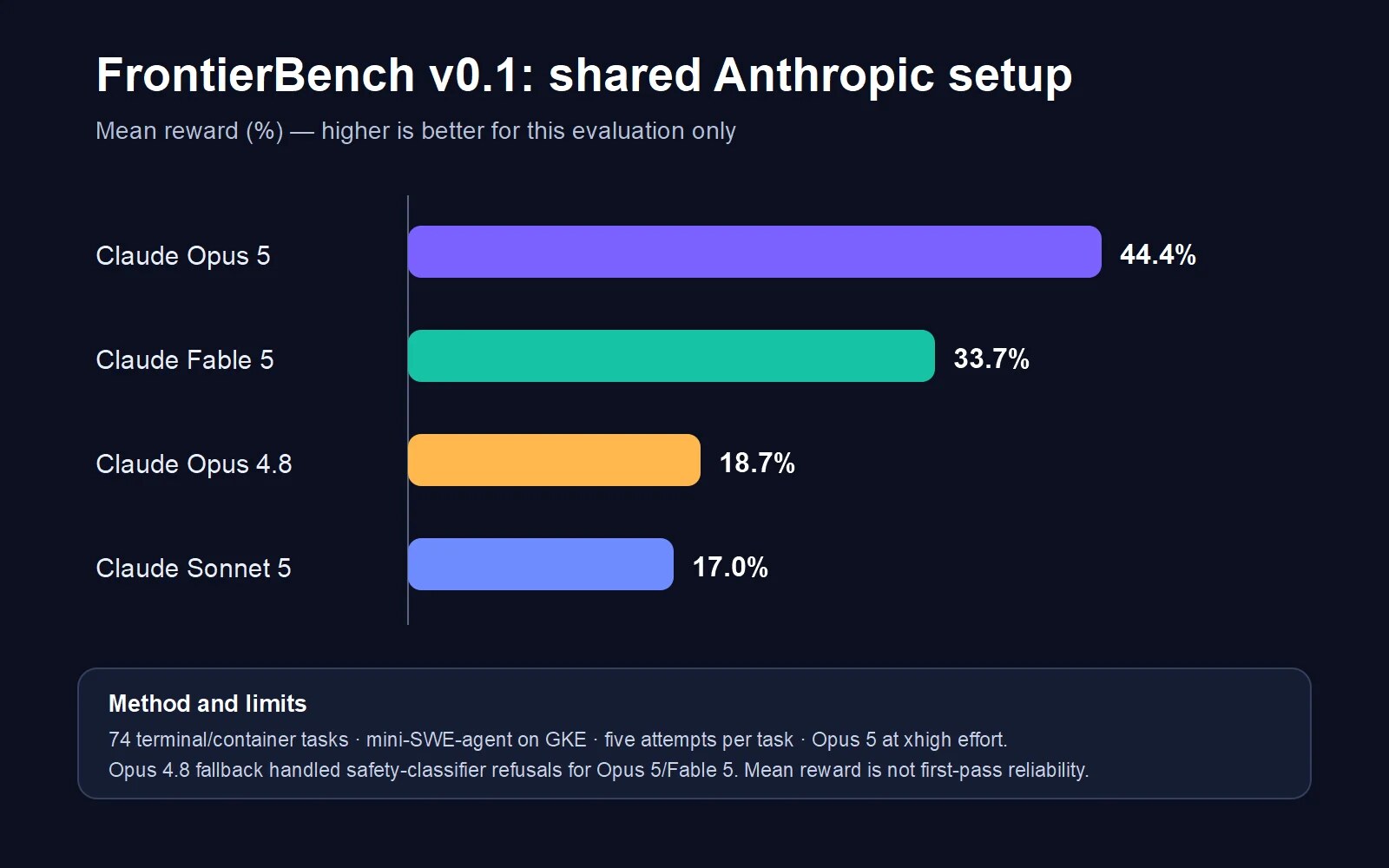
Anthropic’s launch post says Opus 5 more than doubles Opus 4.8’s mean reward on its internal FrontierBench v0.1 run. The underlying system-card result is 44.4% for Opus 5 at xhigh effort versus 18.7% for Opus 4.8, averaged over five attempts on each of 74 tasks using mini-SWE-agent on a GKE backend. The same card reports 30.16% on ARC-AGI-3 at high effort, 70.57% first-attempt success on OSWorld 2.0, and 26.0% on AutomationBench at max effort. These scores answer different questions and are not interchangeable.
Original comparison table: what selected Opus 5 scores actually measure
| Evaluation and Opus 5 result | Evaluator and setup | Interpretation limit |
|---|---|---|
| FrontierBench v0.1: 44.4% mean reward at xhigh in Anthropic’s detailed run; the summary table separately lists Harbor’s 43.3% | 74 terminal/container science and engineering tasks; Anthropic run used mini-SWE-agent on GKE, five attempts per task. Opus 4.8 fallback handled safety-classifier refusals for Opus 5/Fable 5. | Mean over retries is not first-pass reliability; harness, backend, effort and fallback are part of the measured system. |
| FrontierCode 1.1 Main: 53.4% at medium effort | 150 repository tasks, run and scored by Cognition; autonomous container work; mean@5; held-out functional checks plus weighted rubric criteria, including model-graded checks. | Opus 5 declined above high effort because it made extra changes. Fable 5 scored 53.5%, so Opus 5 did not lead this row. |
| ARC-AGI-3: 30.16% RHAE at high effort | Verified by ARC Prize on a semi-private set of interactive, rule-discovery games; efficiency is grounded in human action baselines. Max effort was not tested before launch. | A novel-game efficiency score does not directly measure coding, factuality or business automation. |
| OSWorld 2.0: 70.57% | Anthropic followed default settings on live Ubuntu VMs at 1080p with up to 500 actions; first-attempt success averaged over five runs. Opus 4.8 graded tasks requiring a model grader. | Virtual-desktop tasks and a model grader introduce environment and evaluation dependencies. |
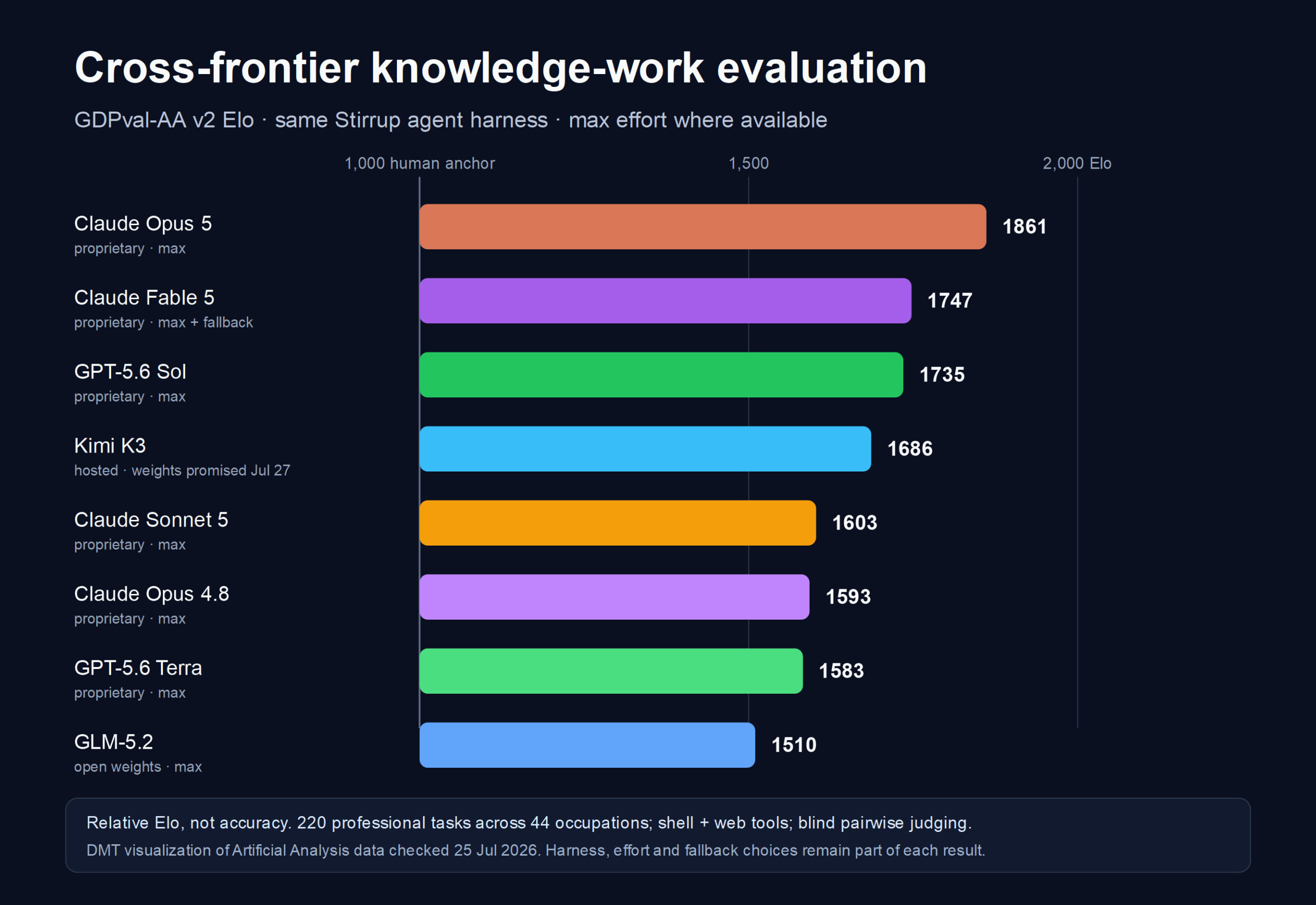
| GDPval-AA v2: 1861 Elo at max | Run externally by Artificial Analysis with its Stirrup agent harness; 220 professional tasks across 44 occupations, with shell/web access; blind pairwise judging of complete deliverables. | Elo is relative to the tested pool and judge method; it is not a percentage accuracy score. |
| AA-Briefcase: 1720 Elo at max | Run externally by Artificial Analysis on private, multi-week project scenarios with thousands of files; combines rubric pass rate, analytical-quality judging and presentation-quality judging. | Private tasks limit reproducibility; model-judge panels and the composite Elo definition matter. Opus 5 did not lead presentation quality. |
| AutomationBench: 26.0% at max; 24% at medium for $0.89/task | Zapier benchmark using a private held-out set of cross-app workflows; agents discover REST endpoints and follow policy documents; deterministic end-state pass/fail grading. | A 26% pass rate is a lead over comparison models, not evidence that unattended business automation is broadly reliable. |
Sources: Anthropic’s System Card, sections 8.1–8.14; ARC Prize’s verified Opus 5 results; Artificial Analysis’s GDPval-AA leaderboard and AA-Briefcase methodology/results; and the original AutomationBench paper. The table is DMT’s original synthesis, not a reproduced vendor chart.
These are meaningful data points. They are not a universal production ranking. At least six details can change the conclusion:
- The harness matters. Agent scaffolds, tools, backend, prompts and graders can move the result.
- Effort is evaluation-specific. The system card’s standard Opus 5 configuration is adaptive thinking at max effort and five-trial averages unless a row says otherwise—but FrontierBench peaks at xhigh, FrontierCode at medium, and ARC-AGI-3 was tested only at high.
- Retries matter. A mean across five attempts answers a different question from first-pass reliability; OSWorld explicitly reports first-attempt success.
- Fallbacks matter. Opus 4.8 served as a fallback for safety-classifier refusals in Anthropic’s internal FrontierBench run and some externally evaluated configurations. The deployed system, not only the named model, may be measured.
- Judges matter. GDPval-AA and AA-Briefcase use pairwise model judging; AutomationBench uses deterministic end-state assertions; FrontierCode mixes held-out tests with weighted rubrics.
- Latency matters. Artificial Analysis found that high, xhigh and max effort averaged 25.7, 34.3 and 36.2 minutes per AA-Briefcase task. Frontier quality may be too slow for an interactive workflow.
- Task distribution matters. A model can lead professional-document tasks and still be the wrong choice for short copy edits, extraction or high-volume customer support.
ARC Prize verified Opus 5 at 30.16% RHAE on ARC-AGI-3 at high effort; because of the short testing window, max effort was not evaluated. Artificial Analysis places max-effort Opus 5 first on GDPval-AA v2 and AA-Briefcase in its July 24 results, but notes that the AA-Briefcase gains are driven more by rubric completion and analytical quality than presentation quality. This is stronger context than repeating a launch chart alone. It still does not answer how the model performs on your repository, documents, language, tool permissions and quality threshold.
Claude Opus 5 vs GPT-5.6 Sol, Kimi K3 and other frontier models
The relevant alternative is not one universal “best model.” It is the deployed system that reaches your acceptance threshold at the lowest defensible combination of cost, latency and risk. GPT-5.6 Sol is the closest proprietary comparison for difficult coding and professional work. Kimi K3 is a relevant open-weight alternative for teams that value deployment control. Gemini 3.6 Flash belongs in the decision set when multimodal inputs, Google tooling, latency or throughput dominate, but its published evaluations are not consistently version-matched with Opus 5. DMT’s GPT-5.6 Sol prompting and model-routing guide covers the OpenAI family in more depth.
Original frontier comparison table
| Model | Comparable evidence available on July 25, 2026 | Price and operating profile | Best-supported use | Important limit |
|---|---|---|---|---|
| Claude Opus 5 | Artificial Analysis Intelligence Index: 61; GDPval-AA v2: 1861 Elo at max; AA-Briefcase: 1720 Elo at max. Anthropic reports 68.8% on DeepSWE v1.1. | $5/$25 per 1M input/output tokens; 1M context; five effort levels. Fast mode is about 2.5x normal speed at $10/$50. | Agentic knowledge work, difficult coding, computer use and mixed-tool workflows where verification is available. | Max-effort runs can be slow and verbose. Some headline results include fallbacks, retries or model judges. |
| GPT-5.6 Sol | Artificial Analysis Index: 59; July 24 GDPval-AA v2 comparison: 1736 Elo; AA-Briefcase: 1495 Elo. OpenAI reports 72.7% on DeepSWE v1.1 versus Anthropic’s 68.8% for Opus 5. | $5/$30; 1.05M context and 128k maximum output. Requests above 272k input tokens receive higher token rates. Multi-agent and programmatic tool calling are available in the Responses API. | Codex-centered software work, parallel agent workflows and computer-use tasks already built around OpenAI’s tool stack. | DeepSWE is a useful counterexample to an Opus sweep, not a universal coding verdict; developer publications can use different harness and effort conventions. |
| Claude Fable 5 | Artificial Analysis Index: 60; July 24 GDPval-AA v2 comparison: 1747 Elo; AA-Briefcase: 1574 Elo. Anthropic’s table gives Fable small leads on SWE-bench Pro and FrontierCode Main. | $10/$50; the highest-priced Claude tier in this set. | Exceptional cases where a local evaluation proves its marginal capability is worth twice Opus 5’s token rate. | It does not lead every shared evaluation, and stricter safeguards or availability constraints may alter the deployed workflow. |
| Kimi K3 (open weight) | Artificial Analysis Index: 57; GDPval-AA v2: 1668 Elo; AA-Briefcase: 1547 Elo, all under the evaluator’s shared methodology. | Hosted API cited by Artificial Analysis at $3/$15; 1M context; low, high and max effort. Model weights and Kimi Code support are available. | Cost-sensitive agents and organizations that need weight access, private deployment options or greater infrastructure control. | Open weights do not mean cheap self-hosting: K3 is a 2.8-trillion-parameter model and requires serious serving infrastructure. Hosted and self-hosted results may not match. |
| Gemini 3.6 Flash | Google reports 83.0% on OSWorld-Verified, 78.0% on Terminal-Bench 2.1 and 1421 Elo on GDPval-AA v2. | $1.50/$7.50; 1M input and 64k output; text, image, video, audio and PDF inputs. | High-throughput multimodal work, evidence finding, computer use and Google-centered agents where Flash economics matter. | Google’s OSWorld-Verified and Anthropic’s OSWorld 2.0 are not the same evaluation version/setup. Do not read 83.0 versus 70.57 as a clean head-to-head. |
Table method: DMT created this comparison from OpenAI’s GPT-5.6 release documentation, Kimi’s K3 release documentation, Google’s Gemini 3.6 Flash model page and Artificial Analysis’s July 24 Opus 5 evaluation, checked July 25, 2026. The Artificial Analysis Index, GDPval-AA and AA-Briefcase rows are the strongest cross-model evidence here because they use a named evaluator and shared harness, although the evaluator worked with Anthropic before the Opus 5 launch and some tasks are private. Developer-reported DeepSWE, OSWorld and Terminal-Bench rows are retained only with their version, effort and harness caveats. Prices are list prices, not cost-per-task guarantees.
Agentic coding: Opus 5 or GPT-5.6 Sol?
There is no clean coding sweep. Anthropic’s summary reports GPT-5.6 Sol at 72.7% on DeepSWE v1.1 and Opus 5 at 68.8%; the evaluation contains 113 long-horizon software tasks written from scratch, and the Opus result averages five trials. On Cognition’s FrontierCode Main, Opus 5 scores 53.4% at medium effort, Fable 5 scores 53.5%, and the GPT-5.6 Sol figure reproduced by Anthropic is 47.5%. That test uses 150 repository tasks, mean@5, container access and a mix of functional and model-graded rubric checks. These rows point in different directions because they test different work through different systems.
Choose Opus 5 when your evaluation favors multi-file implementation, review discipline and the Claude Code toolchain. Choose Sol when Codex integration, programmatic tool calling or parallel subagents are central, or when your own DeepSWE-like tasks show higher acceptance. For either model, record merged tests, review corrections, elapsed time and retries. A repository benchmark score is not a promise that an agent will understand your architecture or stop at the right scope.
Long-horizon autonomous projects
AA-Briefcase provides the most useful common evidence in this package. It evaluates private, multi-week professional scenarios containing thousands of files with the Stirrup agent harness. Opus 5 leads the named set at 1720 Elo at max, ahead of Fable 5 at 1574, Kimi K3 at 1547 and GPT-5.6 Sol at 1495. But max-effort Opus 5 averaged 36.2 minutes per task, the benchmark uses model-judge panels, and private tasks limit replication. The result supports testing Opus 5 for large project synthesis; it does not establish dependable day-long or multi-day autonomy.
Production guidance is conservative: decompose milestones, checkpoint artifacts, restrict permissions, keep resumable state and require tests or human acceptance before the next stage. If a model can wander for hours, its failure cost expands with its action space.
Knowledge work and research
On Artificial Analysis’s July 24 GDPval-AA v2 comparison, max-effort Opus 5 reaches 1861 Elo, followed by Fable 5 at 1747, GPT-5.6 Sol at 1736 and Kimi K3 at 1668. Earlier evaluator and developer pages can show slightly different values as the pool or runs change, which is why the date belongs with the score. The benchmark covers 220 tasks across 44 occupations with shell and web access and blind pairwise judging of completed deliverables. Elo is a relative preference measure, not factual accuracy. For research, require source retrieval, claim-level citations and a separate verification pass regardless of the model.
Gemini 3.6 Flash is a pragmatic alternative for multimodal evidence work and volume. Google reports a lower $1.50/$7.50 API rate and native image, video, audio and PDF inputs. Its GDPval-AA v2 result of 1421 is materially below the frontier configurations above, but a lower-quality model can still win when latency, modality support and scale matter more than the last increment of judged deliverable quality.
Computer use
Anthropic reports 70.57% first-attempt success for Opus 5 on OSWorld 2.0, averaged across five runs on live Ubuntu virtual machines at 1080p with a 500-action limit; Opus 4.8 graded tasks requiring a model judge. Google reports 83.0% for Gemini 3.6 Flash on OSWorld-Verified. Those names sound comparable, but the benchmark versions and product setups differ. No honest article should declare a computer-use winner from those two numbers. Test the exact browser or desktop environment, including login state, pop-ups, recovery from stale pages and destructive-action safeguards.
Pricing, latency and cost per accepted task
Opus 5 has the same $5 input rate as Sol and a lower $25 output rate than Sol’s $30, but nominal token price is not enough. Sol applies higher rates above 272,000 input tokens. Opus Fast mode doubles token price for about 2.5 times normal speed. Artificial Analysis measured max-effort Opus 5 at 52.8 output tokens per second and a 62.68-second time to first token on Anthropic’s API, while its low-effort configuration started much faster in that evaluator’s provider tests. These measurements are snapshots influenced by effort, provider load and output shape.
Use cost per accepted outcome: model charges plus tool fees, retries and human correction divided by accepted deliverables. This is also the durable point in Matthew Berman’s launch-day commentary. It is practitioner judgment, not independent benchmark validation, but it correctly warns against choosing a model from input/output price alone.
Safety, guardrails and open-weight control
Safety cards cannot be collapsed into a single “least restricted” ranking. Opus 5 can route flagged API requests to a fallback model when developers enable that beta behavior, changing capability and price. OpenAI describes trained safeguards, runtime checks, monitoring and access calibrated to risk for GPT-5.6. Kimi K3’s open weights can offer more deployment control and data isolation, but the operator then owns serving security, access control, monitoring and policy enforcement. For regulated or security-sensitive work, compare refusal behavior and auditability on an authorized test set rather than treating fewer refusals as automatically better.
Anthropic’s system-card summary also shows why a universal ranking fails. Fable 5 leads SWE-bench Pro (80.0 vs 79.2), narrowly leads FrontierCode Main (53.5 vs 53.4), and edges the no-tools Humanity’s Last Exam result (56.5 vs 56.3). GPT-5.6 Sol leads DeepSWE v1.1 (72.7 vs 68.8). Mythos 5, not Fable, holds the 66.0 HealthBench Professional result referenced by the table’s footnote. Competitor figures reproduced in a developer system card may still come from different product harnesses or effort conventions.
Pricing, Fast mode and the hidden cost per successful task
At list price, a request with 100,000 uncached input tokens and 10,000 output tokens costs about $0.75 on Opus 5 before cache adjustments: $0.50 for input plus $0.25 for output. The same nominal tokens in Fast mode costs about $1.50. A Fable 5 call at base list price also costs about $1.50. Sonnet 5 costs about $0.30 at its current introductory $2/$10 rate, rising to about $0.45 when the documented $3/$15 standard price begins on September 1, 2026.
That arithmetic is only a starting point. Agentic work can add repeated tool-result inputs, cache writes, cache reads, long reasoning output, retries and subagents. The correct metric is:
Total workflow cost ÷ number of accepted outcomes
A $3 run that succeeds once can be cheaper than three $1 attempts. Conversely, using max effort for a task Sonnet solves reliably is waste. Fast mode is rational when reduced waiting changes developer throughput, customer experience or an incident response; it is not a default quality upgrade.
What launch-day users are saying
Reddit and indexed X discussion converged on four themes. First, many users described a noticeable improvement in coding speed, implementation quality and willingness to finish the task. Second, Max and Pro users worried about session and weekly limits, with reports ranging from surprisingly low consumption to hitting limits quickly. Third, some users questioned whether max-effort benchmarks reflect normal interactive use. Fourth, people remained unsure whether better short demonstrations translate into reliable multi-hour autonomous work.
None of this is controlled evidence. People use different plans, effort settings, repositories, tools and conversation lengths. Some comments are jokes; selection bias favors unusually good or bad experiences. The right conclusion is that Opus 5 deserves testing, not that social sentiment has settled the question. For subscription users, Claude’s 2026 rate-limit system is the more useful operational reference.
Matthew Berman’s July 24 edited Opus 5 review and launch livestream are useful examples of practitioner interpretation, with an important limit. He argued for cost per completed task, compared launch charts and started a Rubik’s Cube simulator in Claude Code; roughly nine minutes and 46,000 tokens into the livestream, the task was still running and his stream capture was failing, so the video did not establish a finished comparative result. DMT verified Matt Wolfe’s July 24 AI news video too: it discusses Kimi K3, GPT-5.6 Sol and Anthropic/Fable, but not Claude Opus 5. It is therefore not evidence for an Opus 5 verdict.
Is Claude Opus 5 realistically effective?
Yes—within a bounded workflow. Opus 5 is most likely to earn its premium on difficult debugging, code review, multi-file features, messy research synthesis, spreadsheets with real formulas, document transformation, browser tasks and analytical work where a shallow answer creates expensive rework. Its lower effort settings make it more plausible as a daily model than Fable 5.
It is not a dependable autonomous employee. Anthropic itself says important limits remain on long-running autonomous biological research. A million-token context does not guarantee that every buried fact receives equal attention. Self-verification reduces some errors but cannot establish truth when sources, tests or permissions are missing. Safety classifiers and fallbacks can also change which model completes part of a workflow.
A practical model-selection test
- Collect 20–50 representative tasks, including routine, hard and failure-prone cases.
- Define acceptance before running: tests passed, factual citations valid, spreadsheet reconciled, or reviewer score.
- Run Sonnet 5 and Opus 5 at low, medium and high effort. Add xhigh/max only for tasks that fail.
- Record token cost, wall-clock time, human correction minutes, retries and refusal/fallback behavior.
- Route by task class. Do not choose one model for everything.
- Repeat after major model, harness or prompt changes.
This is the same principle behind a mature agentic AI workflow: autonomy expands only after the acceptance checks are observable.
Verdict
Claude Opus 5 looks like the strongest default for difficult Claude work, not the automatic default for every request. It keeps Opus 4.8’s base API price, approaches or exceeds Fable 5 on several published evaluations, and gives teams a five-step effort dial. Results run by ARC Prize, Cognition and Artificial Analysis support parts of Anthropic’s broad capability story, while also showing limits: Opus 5 does not lead every task, medium effort can beat higher settings, and frontier-quality knowledge-work runs can be slow.
Use Sonnet 5 for routine volume, Opus 5 for hard work with measurable acceptance criteria, and Fable 5 only where a local evaluation proves the extra spend. Treat launch benchmarks as hypotheses about where to test—not substitutes for testing.
Frequently asked questions
How much does Claude Opus 5 cost?
The Claude API base price is $5 per million input tokens and $25 per million output tokens. Fast mode is $10 and $50 respectively. Caching, tool loops, output length and retries change the effective cost.
Is Opus 5 better than Fable 5?
Not universally. Anthropic reports Opus 5 leading several coding, automation and computer-use evaluations at lower cost, while Fable 5 remains the higher-capability tier and leads some tasks. Test both on the work that matters.
Is Opus 5 worth using instead of Sonnet 5?
For difficult, ambiguous or high-cost-of-error tasks, often yes. For routine generation, extraction and well-specified coding, Sonnet 5 may produce a better cost-throughput result.
Does the 1M-token context mean Opus 5 can understand an entire codebase?
It can ingest very large inputs, but capacity is not perfect recall. Retrieval quality, file relevance, repository maps, tests and tool feedback still matter.
Should I use max effort?
Only when your evaluation shows a meaningful quality gain. Start at high, test medium and low for savings, and reserve xhigh/max for the hardest cases.
Does Opus 5 win every benchmark?
No. Anthropic’s own summary table shows Fable 5 ahead on SWE-bench Pro, FrontierCode Main and HLE without tools, while GPT-5.6 Sol leads DeepSWE v1.1. Scores also use different harnesses, effort settings and graders, so no row is a universal real-world ranking.
Is Claude Opus 5 better than GPT-5.6 Sol?
It depends on the task and tool stack. Opus 5 leads shared Artificial Analysis knowledge-work evaluations, while Sol leads the developer-reported DeepSWE v1.1 comparison and may fit Codex-centered or parallel-agent workflows better. Run both at matched acceptance criteria, effort and permissions.
Is Kimi K3 a practical open-weight alternative?
Yes for teams that value hosted savings or weight access and can evaluate the deployment. Its 2.8-trillion-parameter scale makes self-hosting an infrastructure decision, not a free substitute for a managed API.
Method note: Anthropic’s announcement, Platform Docs and System Card are the factual source of record for model specifications and Anthropic-run evaluations. ARC Prize and Artificial Analysis are named for results they ran. OpenAI, Kimi and Google documentation is the source of record for their own specifications. Creator and community reaction remains anecdotal. Pricing, availability and benchmark leaderboards were checked on July 25, 2026 and can change.
Once you have chosen where Opus 5 belongs in your stack, use DMT’s Claude Opus 5 prompting and workflow guide to turn that model choice into bounded tasks, verification checks and cost controls.
About the author: Tayeeb Khan is a digital marketing strategist and SEO specialist who writes DMT’s practitioner-focused analysis of AI tools, marketing systems and technical workflows. This article is an evidence review, not a claim of hands-on independent model benchmarking.