
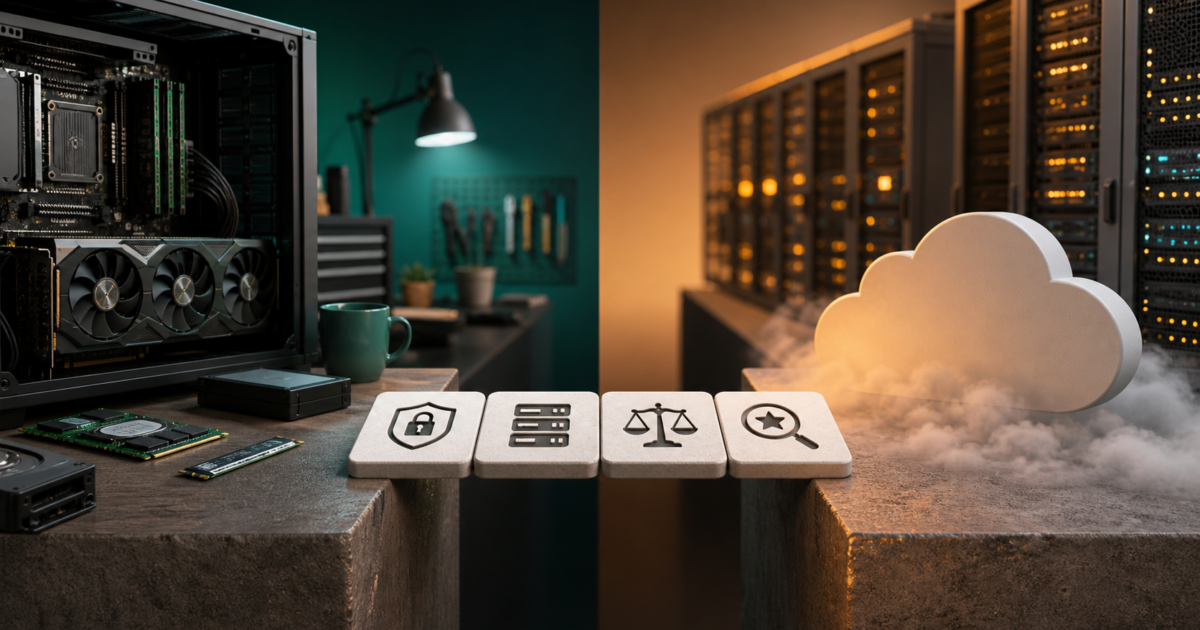
Short answer: Qwen3.8-Flash-Next is an experimental open-weight preview of Qwen’s next architecture, not a small drop-in model for every laptop. For a marketing team, the useful decision is whether to run a controlled, privacy-sensitive local evaluation or use the managed Qwen3.8-Flash service. Treat community speed and hardware posts as test ideas, not guarantees. The open model’s official model card lists 262,144 native context tokens, extensible to 1,000,000, while QwenCloud documents 1,000,000 tokens for its hosted Qwen3.8-Flash service; those are different operating decisions.
Checked 31 August 2026. This guide reports what official documentation and the llama.cpp support record establish. It does not claim a local benchmark, account access, production performance, or a particular hardware result.
What Qwen released
Qwen’s official release describes Qwen3.8-Flash-Next as the first open-weight release under an architecture intended to underpin Qwen4. The dedicated repository records the open-weight release date as 26 August 2026. The official Hugging Face model card calls it an experimental preview and provides weights and configuration files for Transformers-compatible tooling. The official Qwen3.8-Flash-Next repository points readers to local and hosted paths, but a link to a framework is not proof that every build, accelerator, or quantization is production-ready.
That distinction matters for content and campaign teams. A local model can be attractive when a brief contains confidential customer, pricing, or planning information. It also puts model files, framework versions, memory planning, observability, and quality controls in your team’s hands. A hosted service reduces infrastructure work but introduces account, data-governance, cost, and availability questions that must be checked against the current provider documentation.
Two similar names, two different decisions
| Question | Qwen3.8-Flash-Next | Qwen3.8-Flash on QwenCloud |
|---|---|---|
| What is it? | Open-weight experimental preview. | Official managed service based on the preview with production features. |
| Where do the official instructions point? | Hugging Face Transformers, vLLM, SGLang, TokenSpeed, and compatible local tooling. | QwenCloud developer documentation and API-compatible access. |
| Context described by the provider | 262,144 native; extensible to 1,000,000 on the model card. | 1,000,000-token context in the current QwenCloud specification. |
| Best first marketing question | Can a bounded private workflow meet our quality and operational gates on our own stack? | Does managed access meet our data, cost, latency, and integration requirements? |
The model card explicitly says Qwen3.8-Flash is the official version based on Qwen3.8-Flash-Next with more production features, including a one-million-token context by default and built-in tools. Do not merge the two names in a headline or imply that a local preview automatically has the hosted service’s tools, limits, pricing, or support.
The current QwenCloud documentation identifies the hosted model as model ID qwen3.8-flash. Treat that identifier, its capabilities, and its access path as current hosted documentation; do not transfer them automatically to a local checkpoint.
Architecture details that change the evaluation plan
The release and model card describe several changes that are relevant to a marketer evaluating long documents or agent workflows:
- Hybrid attention: Gated DeltaNet is paired with Qwen Sparse Attention (QSA). QSA works at micro-block level rather than selecting individual tokens.
- Gated residual streams: the design uses widened residual streams with read and write gates. This is an architecture detail, not a promise of better copy or campaign results.
- N-gram embedding: the model card lists 51B n-gram-embedding parameters, in addition to the 125B language model with 6B activated per token and a 4B MTP component. “6B active” should not be read as “a 6B model that fits in 6B-model memory.”
- Multimodal input: the official card provides text-and-image examples and documents compatible serving paths. A workflow that interprets screenshots still needs a human check for layout, claims, and accessibility.
For a practical primer on memory planning and local runtimes, start with DMT’s low-VRAM local LLM guide. It is the existing canonical owner for general llama.cpp, PyTLLM, and Swap-MoE context; this article covers the separate Qwen release and the marketer’s local-versus-hosted decision.
What llama.cpp support proves—and what it does not
llama.cpp pull request 27742 was merged on 27 August 2026. Its description says the change adds Qwen3.8-Flash-Next (qwen4exp) support across the converter, text graph, sparse attention, vision path, and several quantizer fixes. The same PR documents a 97.7 GiB n-gram hash table and records architecture-specific correctness caveats, including divergence above the QSA budget and limitations in its synthetic test coverage.
A merged PR is useful evidence that support work landed upstream; it is not a blanket promise that a packaged binary, backend, quantization, or hardware path is stable. The project recommends checking current framework versions. The official issue for HIP/gfx1151 reports a setup-specific decode-rate cliff after roughly 1K context tokens in one Strix Halo configuration. That report is valuable as a risk to test, but it is not a universal Qwen performance benchmark.
Use the project’s current release and issue history as part of a reproducible test record. Do not turn a Reddit setup, a single speed number, or a patch tag such as b10707 into a general hardware recommendation.
A marketer-safe evaluation plan
- Define one reader job. Start with a bounded task such as turning an approved product brief into a fact table, clustering search questions, or proposing an outline with source citations. Keep sensitive inputs redacted until your data policy is clear.
- Freeze a prompt set. Use the same prompts, source packet, output schema, and acceptance rules for local and hosted runs. Save model ID, checkpoint or framework version, quantization, context length, and relevant serving flags.
- Score accepted work, not raw output volume. Check factual support, instruction adherence, brand constraints, citation completeness, edit burden, and failure modes. DMT’s cost-per-accepted-result calculator is a useful structure for recording this without inventing a success metric.
- Test long-context claims separately. A one-million-token specification does not mean every prompt should be that long or every backend will behave identically. Include short, medium, and deliberately long cases, and record where quality or latency changes.
- Keep publishing behind a human gate. Local inference can help with drafts and classification; it does not authorize automatic WordPress, ad, social, or email changes. Use the agent-harness controls guide and AI marketing automation guide for approval, logging, and rollback boundaries.
When local is the better first test
Choose a local proof-of-concept when the primary question is data boundary, offline access, controllable versioning, or whether a private workflow is worth the infrastructure. Plan for a model footprint larger than the active-parameter headline suggests, plus the n-gram table, context cache, runtime overhead, and quantization trade-offs. A 16GB GPU question cannot be answered honestly from “6B active” alone.
Choose hosted Qwen3.8-Flash when you need managed scaling, documented service capabilities, or a quick comparison without maintaining a large local stack. Read the current QwenCloud model page for the live context, capability, and access details. Do not copy current pricing from a third-party page into a durable article when the provider directs readers to its model gallery.
Teams that already work with multiple model families can use DMT’s GPT-5.6 model-selection guide, Claude workflow guide, and Luna Max Codex guide as comparison infrastructure. DMT’s AI in digital marketing overview and technical SEO guide add workflow and verification context. The point is not to crown one model; it is to make the acceptance criteria and operating boundary explicit.
What the community signal says
The release-day LocalLLaMA megathread, quantization discussion, hardware questions, and Unsloth thread show immediate interest in getting the preview running. Independent write-ups from KubeSimplify, Chris Malpass, and Traictory add useful setup context. They are still reports from particular machines, builds, or authors. They do not establish a minimum specification, a universal speed, or marketing-task quality.
That is the right way to use community evidence: as a map of questions to reproduce. If a setup claims that a quantization or SSD-offload path works, record the exact model files, runtime commit, memory layout, prompt length, and output checks before repeating the claim. A community vote or anecdotal success is not a substitute for the official model card, a controlled comparison, or a rights and privacy review.
Frequently asked questions
Is Qwen3.8-Flash-Next the same thing as Qwen3.8-Flash?
No. Qwen describes the hosted Qwen3.8-Flash as the official version based on the open-weight preview with additional production features. Keep local weights, hosted capabilities, access, and pricing as separate claims.
Can a 16GB laptop GPU run it because only 6B parameters are active?
There is no universal yes or no from the active-parameter figure. The model card also lists the 125B language model, n-gram embeddings, MTP component, context state, quantization, and serving framework. Hardware reports are setup-specific; validate the exact artifact and workload.
Does the local model automatically have a one-million-token context?
No automatic guarantee follows. The model card describes 262,144 native context and extension up to 1,000,000, while QwenCloud documents one million for its hosted service. Actual support depends on the framework, checkpoint, memory, context settings, and workload.
Is llama.cpp support production-ready?
The upstream PR was merged, which is a meaningful compatibility milestone. It does not remove backend-specific caveats. Start with a pinned build and a small acceptance suite, and treat open issues such as the HIP/gfx1151 report as test cases rather than universal failures.
Should a marketing team publish a Qwen comparison immediately?
Publish a source-led decision guide, not a performance verdict. State the release date, distinguish open and hosted versions, disclose setup-specific community signals, and keep any workflow claim behind a reproducible evaluation and human review.
Bottom line
Qwen3.8-Flash-Next is worth watching because it brings an open-weight, multimodal preview with an unusual hybrid architecture and a rapidly moving local-tooling ecosystem. The marketer’s opportunity is a disciplined comparison: private local pilot versus managed hosted service, judged by accepted work and operational risk. That is more durable than repeating a community benchmark or presenting “6B active” as a hardware answer.
Sources checked
- Qwen official Qwen3.8-Flash-Next release post
- Qwen3.8-Flash-Next official model card
- Qwen3.8-Flash-Next official repository README
- QwenCloud current Qwen3.8-Flash documentation
- llama.cpp PR #27742 and issue #27856
- Community and independent setup reports linked in the community-signal section; these are explicitly treated as signals rather than proof.