
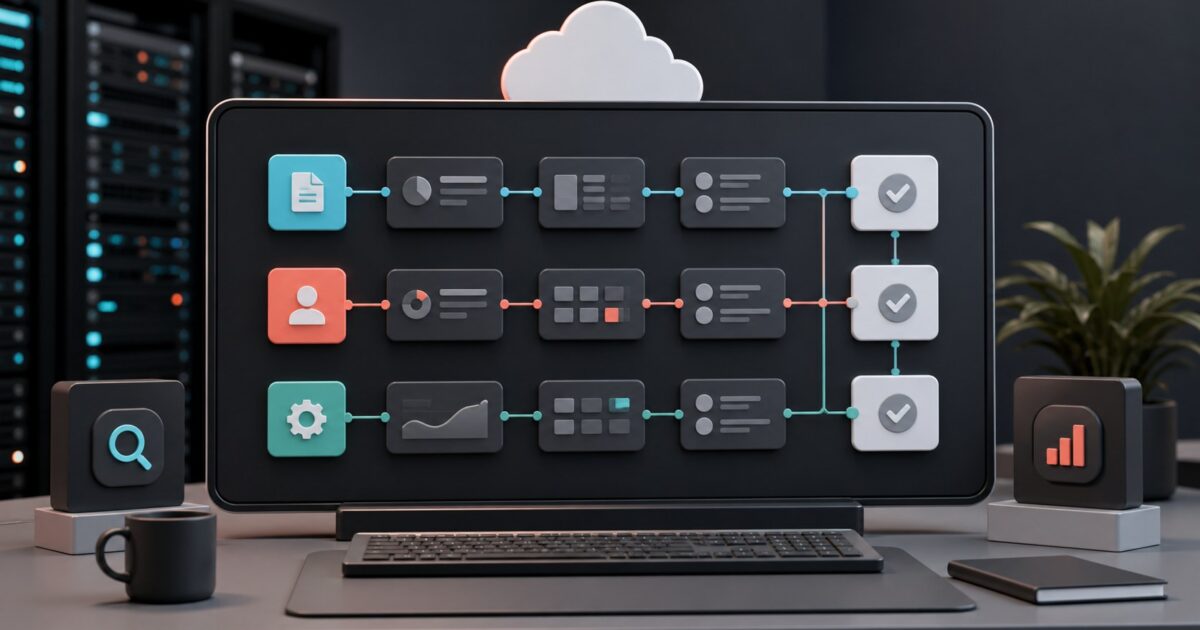
Grok Bot is an AI agent that works on a persistent cloud computer, so it can continue browser and app tasks while your laptop is closed. Its Bots can coordinate and reuse routines, but all Bots under one Cursor user share that user’s files, browser sessions and app logins. They are not separate security environments.
xAI launched Grok Bot in beta on 11 August 2026. Current Cursor documentation describes access for paid individual plans and self-serve Teams, plus a separate Enterprise activation path and individual SuperGrok or X Premium+ account links. The useful question is whether its persistent computer fits your workflow, and what access, usage and approval boundaries you should check before relying on it.
Grok Bot at a glance
- What it is: Named AI teammates that work in a persistent Cursor-hosted cloud computer with a browser, filesystem and terminal.
- What persists: Work can continue when your laptop or phone is closed; Bots retain their own conversations and preferences.
- Computer boundary: One computer is assigned to each user. That user’s Bots share its files, browser sessions and app logins; different users are isolated.
- Platforms: Cursor’s desktop apps for macOS, Windows and Linux, plus iPhone.
- Access: Paid Cursor individual plans and self-serve Cursor Teams include access. Enterprise requires account-team enablement. Some individual SuperGrok plans and X Premium+ can be linked.
- Usage: Eligible plans include weekly usage. Extra on-demand usage can be billed through Cursor when enabled; there is no single public Enterprise price in the documentation reviewed.
- Status: Beta. A supported website may still block automation, expire a session or require a person to complete a login or other step.
What “a computer of its own” means
Grok Bot’s work happens on a cloud computer rather than inside the browser window on your laptop. The computer has a browser, files and a terminal. Bots can use available plugins or interact with software through the computer interface, which makes workflows possible even when a service has no API connection. Closing the Cursor app or your device does not stop a background turn or routine.
The computer belongs to your Cursor account, not to an individual Bot. Cursor’s documentation says each user runs in a separate Firecracker microVM, while every Bot for that user shares the same computer, files, browser sessions and app logins. Bot conversations and learned preferences stay separate, but that is not a security boundary: one Bot may encounter material another Bot placed on the shared computer. If you need a separate credential or work environment, use a separate user account and confirm the consequences with your administrator.
A website can still reject automated access, expire a session or pause for a human login, two-factor check or payment step. Treat “works while I’m away” as a description of hosted execution, not a promise that every task completes without supervision.
How Grok Bot coordinates several agents
You can create named Bots for different roles, message them in a group, and hand a task from one to another. Cursor says Bots can work in parallel and each gets its own screen on the shared computer; one Bot runs one computer-use task on its screen at a time. That detail matters when a workflow depends on several Bots manipulating the same website at once.
A Bot can also learn a routine from a demonstrated process and run it again later. Treat the routine as a repeatable starting point, then inspect the steps and outputs after software, page layouts or permissions change. Memory and a saved routine reduce repeated setup; they do not make a workflow correct by themselves.
Where human approval still belongs
Grok Bot can ask before an action, and Cursor’s Auto Review can evaluate selected risky actions. Current documentation says Auto Review covers shell commands, plugin calls, computer use, automation changes and delegation. Enterprise admins can enforce it and add team rules. The same documentation says it does not review every side effect, including memory writes and many settings changes, so approval and review are layers to configure rather than a blanket safety guarantee.
Start with a request that names the allowed work and the stop point. For example: “Review this week’s campaign pacing, cite the source rows, and draft a list of proposed changes. Do not edit budgets or message anyone. Stop and show me the current and proposed values.” Prefer scoped service accounts and “allow once” for actions involving external messages, money, publishing, deletions or shared records. Never paste credentials into a chat.
How access and usage work now
The August launch page described a narrower early-beta audience. Current Cursor plan and billing documentation is the better reference for access and usage as of 23 September 2026:
| Access route | What the current docs say | What to check |
|---|---|---|
| Paid individual Cursor plan | Pro, Pro+ and Ultra include access; their weekly usage allowances differ. | Check the plan screen for the account’s current allowance and on-demand setting. |
| Self-serve Cursor Teams | Every member can use Grok Bot without a Premium seat or separate admin request. Usage follows that seat’s plan allowance; on-demand is enabled by default. | Legacy request-based plans and Privacy Mode (Legacy) are exceptions. Confirm the team’s settings and monthly on-demand cap. |
| Cursor Enterprise | An account executive enables access. An admin can enable it for the team or limit it to groups; usage is admin-managed. | Ask the account team to confirm contract, seat and billing treatment. The public docs do not give a universal Enterprise rate. |
| Individual SuperGrok or X Premium+ | Some individual SuperGrok tiers and X Premium+ can be linked to a Cursor account as a usage grant. | The grant does not stack on top of an existing Cursor plan. Linking is permanent, so use the intended Cursor account. |
Included weekly usage resets weekly. After it runs out, extra usage can continue as on-demand through Cursor if that setting is enabled, and it counts toward the monthly on-demand limit. This is separate from the weekly grant. The plan screen is the practical place to check the account’s current meter; this guide has not checked a customer account or invoice.
xAI’s 3 September Enterprise announcement offered two weeks of free use and said organizations could invite people without an existing seat. That dated offer period has passed by this 23 September review unless a customer has a separate extension. Current Cursor docs describe invitations for existing team users and new users, but do not establish how an invitee without a seat is billed or whether a seat is free. Do not infer ongoing free access from the launch wording. Cursor’s separate trial documentation describes usage credit with a seven-day window, not the two-week Enterprise promotion.
What xAI’s support case study does and does not show
In a 22 September case study, xAI said its combined support team handled 175% more tickets without adding staff. It estimated that it might otherwise have hired 200 additional people; that is a counterfactual estimate, not a count of hires actually avoided. xAI also said some resolutions cost $0.20–$0.30 after minor optimization.
These are xAI’s internal, self-reported results. The post does not provide an independently audited comparison, a defined measurement window, a full denominator or a cost methodology that would let another support team reproduce the figure. Treat the numbers as one company’s case study, not a forecast, benchmark or Enterprise seat price. The transferable part is the rollout method xAI describes: begin with a narrow workflow, keep early writes behind human approval, review traces and outcomes, then expand only after the first results hold up.
What to verify before trusting it with work
Current security documentation adds detail that was absent from the original August announcement. It is still vendor documentation, not an independent audit or proof that a particular organization has configured the controls.
- Access and identity: A Bot has no access by default; members grant app or connector access. Cursor accounts use the team’s sign-in setup, and Enterprise adds SCIM provisioning. Confirm who can enable the product and revoke access.
- Network boundaries: Enterprise Network Controls can restrict destinations. Self-serve Teams do not have that destination allowlist, and a team without a network policy defaults to allow-all. Hosted computers use shared static egress IP addresses; dedicated per-customer IPs are not offered.
- Action records: Action Recording is off by default and is separate from Audit Logs. Audit Logs cover admin, security, authentication and control-plane events; Action Recording captures selected Bot actions. Confirm which events are retained and where they are exported.
- Data location and deployment: Hosted computers run in the United States today. Cursor says that is not the same as its separate US-only data-residency program. On-premises, inside-customer-perimeter and bring-your-own-image deployments are not supported.
- Model routing: Cursor manages model selection; there is no customer-facing model picker. Enterprise model allowlist enforcement is not guaranteed. Ask the account team how this fits any contractual model or subprocessor restrictions.
For a first evaluation, write down the workflow, the accounts it needs and the actions it must never take. Use a read-heavy task with a clear finish line; check the network policy, on-demand setting, approval behavior and audit path before adding access to production tools.
Practical uses for marketing and operations teams
The product is most useful when a task crosses tools and produces work a person can inspect. These are candidate workflows, not claims that Grok Bot has been independently tested on them:
- Research brief: gather public information about five target accounts, link each fact to its source and leave a draft summary for review.
- Campaign monitoring: inspect approved pacing data and prepare an exception list without changing budgets.
- Content QA: check a staging page for broken links or missing product details, then produce a correction checklist.
- Competitive monitoring: compare public product or pricing pages and flag a material change for a person to verify.
- CRM hygiene: suggest updates from approved notes while leaving the actual record write behind an approval step.
A useful beta test should measure outcomes, not activity
Choose one repeatable task and define the input, expected output, evidence required and stop condition. Run several realistic cases, including an expired login, an ambiguous record and an interrupted task. Record whether the Bot completed the work, whether its claims were supported, how much correction was needed, how long it took, what usage the account meter showed and where it paused for approval. This is a proposed test protocol; no DMT-run Grok Bot experiment is claimed here.
Keep the first version in observation mode: ask for drafts, evidence and recommendations, but do not let it send messages, publish pages, spend money or change production settings. Expand only when the saved output is easy to check and the failure cases stop safely. For a broader framework, see DMT’s AI agent harness and production-controls guide and scheduled-agent monitoring checklist.
How it differs from other agents
Grok Bot’s defining choice is a persistent cloud computer shared by a user’s Bots, with parallel coordination and saved routines. That fits work that moves through browser-based systems and can pause for review. A coding agent may be a better fit for repository changes; a chat assistant can be simpler for one-off research or copy; an API workflow may be easier to test and audit for fixed, repeatable backend jobs. These are task-fit distinctions, not measured claims that one product is more reliable than another.
For model-specific product details, DMT has a separate Grok 4.6 pricing and availability guide. It covers the Grok model release, not Grok Bot’s Cursor usage or Enterprise pricing. See also the AI coding-agent comparison and the cost per accepted result method.
What users are asking online
A small sample of recent Cursor and Grok Bot discussions includes questions about usage pools, billing and how usage is counted. One user report describes apparent usage-pool confusion, while another thread asks how Grok Bot’s limit works. These posts are useful prompts to inspect the account’s model routing and usage screen; they do not establish how often the issue occurs or what every plan does.
DMT verdict
Grok Bot is worth a narrow beta when you need a persistent agent to move across browser-based tools and can keep its work reviewable. Its shared computer helps Bots hand off context, but it also means a user’s Bots share files, sessions and logins. Begin with a scoped account, a read-heavy task and an explicit stop condition; check the usage meter, on-demand billing and approval behavior before expanding its permissions.
For Enterprise, confirm enablement, group access, seat and billing treatment, network policy, logging, data location and any model restrictions with the account team. The September two-week offer is historical, and xAI’s support metrics are not a promise of another organization’s results.
Sources
- xAI, “Introducing Grok Bot” (11 August 2026)
- xAI, “Grok Bot is now included with more plans” (26 August 2026)
- xAI, “Grok Bot for Enterprise” (3 September 2026)
- xAI, “How SpaceXAI is using Grok Bot to scale customer support” (22 September 2026)
- Cursor documentation, Grok Bot overview and shared computer
- Cursor documentation, plans and billing
- Grok Bot documentation, teams and enterprises
- Grok Bot documentation, security
- Grok Bot documentation, security FAQ
- Grok Bot documentation, identity and access
- Community signal: a user report about usage-pool confusion
- Community signal: a billing discussion
- Community signal: a question about the weekly limit
Reviewed 23 September 2026. Access, plan, security and product-capability claims follow vendor documentation; the support metrics are self-reported results from the xAI case study. These are not independent product or security audits. Community comments are anecdotal and only suggest questions to test.