


Anthropic launched Claude Opus 5 on July 24, 2026, positioning it as an everyday frontier model that approaches Claude Fable 5 capability at half Fable’s token price. It is now the default model for Claude Max and Anthropic calls it the strongest model available on Claude Pro. For developers, the model ID is claude-opus-5; the headline API price is $5 per million input tokens and $25 per million output tokens.
Those are official launch facts, not a conclusion that Opus 5 is universally the best model. Anthropic’s July 24 announcement, platform documentation and 194-page System Card describe a substantial jump over Opus 4.8 in agentic work, coding, computer use and professional tasks. Several important results were externally run by named evaluators. The evidence is still launch evidence: task definitions, effort settings, tools, retries, fallbacks and graders materially affect every score.
Claude Opus 5 launch: the essential facts
| Launch detail | Confirmed position on July 25, 2026 | Reader implication |
|---|---|---|
| Release | July 24, 2026 | A new Opus generation, not an Opus 4.8 alias |
| Claude plans | New default on Max; Anthropic calls it the strongest model on Pro | Exact usable volume still depends on plan, workload, context and tools |
| API | claude-opus-5; available to all Claude API customers | Migration needs a behavior and cost re-baseline, not only a model-name change |
| Cloud platforms | Amazon Bedrock, Google Cloud and Microsoft Foundry are documented launch surfaces | Model naming, regional support and platform pricing can differ |
| Context and output | 1 million input tokens by default and maximum; up to 128,000 output tokens | Capacity is not proof of equal attention to every token |
| Base API price | $5 input / $25 output per million tokens | Same headline rate as Opus 4.8 |
| Fast mode | Research preview, roughly 2.5× normal output speed; $10/$50 | First-party Claude API only; unavailable on partner cloud platforms |
| Thinking and effort | Adaptive thinking is on by default; low, medium, high, xhigh and max effort | Effort is a cost/latency/quality control, not a “better” button |
The announcement’s “available on all platforms” language needs surface-specific context. Anthropic explicitly names Claude Max and Pro, the Claude API and partner cloud platforms. It also documents Opus 5 safeguards and automatic Opus 4.8 fallbacks in Claude.ai, Claude Code and Claude Cowork. It does not publish one universal message allowance for every subscription. DMT’s Claude rate-limit explainer covers why model access, context capacity and usable plan volume are different questions.
Why Anthropic launched Opus 5 now
Opus 5 fills a deliberate space in the Claude family. Sonnet remains the high-volume option. Fable is the higher-priced frontier tier for unusually demanding workloads. Opus is being repositioned as the model people can use every day when Sonnet is not enough but Fable’s $10/$50 token rate is difficult to justify.
That position explains the launch emphasis on cost per completed task. Anthropic repeatedly charts performance against task cost at different effort settings instead of presenting only a maximum score. The practical claim is not simply “more intelligence.” It is that teams can approach the harder tier on many tasks while keeping the Opus 4.8 list price. Readers choosing among specific models should use DMT’s source-audited Claude Opus 5 benchmark and frontier comparison; this news article stays focused on what launched and the evidence boundary.
What changed from Claude Opus 4.8
- Thinking is on by default. An Opus 4.8 integration that omitted a thinking field can behave differently after changing the model name.
- Effort matters more. Low and medium can reduce token use and response time; xhigh and max give the model more room, but can also increase latency, verbosity or scope expansion.
- The context window is one million tokens. There is no smaller Opus 5 context variant in the API documentation.
- Maximum output is 128,000 tokens. Because thinking and visible output share the
max_tokensceiling, migrations may need a larger allowance. - Tools can change mid-conversation in beta. Developers can add or remove tools without automatically invalidating the prompt cache.
- Server-side default fallbacks are in beta. Flagged requests can route to Anthropic’s recommended fallback rather than simply stopping.
- The minimum cacheable prompt is 512 tokens. That is half Opus 4.8’s 1,024-token minimum.
Anthropic describes Opus 5 as more proactive, thorough and willing to verify its work. That can be valuable for debugging, research and multi-file changes. It can also widen a task beyond what the user intended. The model-specific official prompting guidance recommends complete specifications, explicit scope, effort testing and limits on subagent spawning. DMT’s practical Opus 5 prompting and workflow guide turns those behaviors into acceptance checks and cost controls.
Pricing, Fast mode and the cost question
The base Claude API rate is $5 per million input tokens and $25 per million output tokens. Anthropic’s pricing documentation separately lists prompt caching, batch processing, tool use and data-residency modifiers. A long agent run can therefore cost more than its initial prompt suggests: tool output returns as context, retries consume more tokens, and high effort can create more turns.
Fast mode is a research preview. Anthropic says it can produce tokens at roughly 2.5 times the normal speed, priced at $10/$50 per million input/output tokens. It is available on the first-party Claude API, not Amazon Bedrock, Google Cloud or Microsoft Foundry, and is not available with the Batch API. Claude Code can access it through usage credits. Buying Fast mode makes sense only when wall-clock delay costs more than the price premium.
The meaningful launch benchmarks—and what they actually test
Anthropic’s launch page contains many charts, but there is no honest single “Opus 5 benchmark score.” The model was evaluated across terminal tasks, repository work, interactive games, virtual desktops, professional deliverables and business automation. The table below is an original DMT summary; it does not reproduce an Anthropic or creator chart.
| Evaluation | Reported Opus 5 result | Test context | What not to infer |
|---|---|---|---|
| FrontierBench v0.1 | 44.4% mean reward at xhigh in Anthropic’s detailed run | 74 container/terminal science and engineering tasks; mini-SWE-agent on GKE; five attempts per task; Opus 4.8 fallback on certain safety refusals | Not first-pass reliability and not a model-only measurement. The summary table separately lists Harbor’s 43.3% run. |
| FrontierCode v1.1 Main | 53.4% at medium effort | Cognition-run 150-repository-task evaluation; autonomous containers; mean@5; functional checks plus weighted and model-graded criteria | Opus 5 did not lead this row; higher effort reduced its score through extra changes. |
| ARC-AGI-3 | 30.16% RHAE at high effort | ARC Prize-verified semi-private interactive games; efficiency grounded in human action baselines | Max effort was not tested, and game efficiency is not coding or factual accuracy. |
| OSWorld 2.0 | 70.57% first-attempt success | Live Ubuntu virtual machines at 1080p, up to 500 actions, averaged over five runs; some tasks used a model grader | Not a guarantee that arbitrary real desktops or websites will work reliably. |
| GDPval-AA v2 | 1861 Elo at max effort | Artificial Analysis Stirrup agent, shell and web; 220 professional tasks; blind pairwise judging | Elo is relative to the tested pool and judge method, not percent accuracy. |
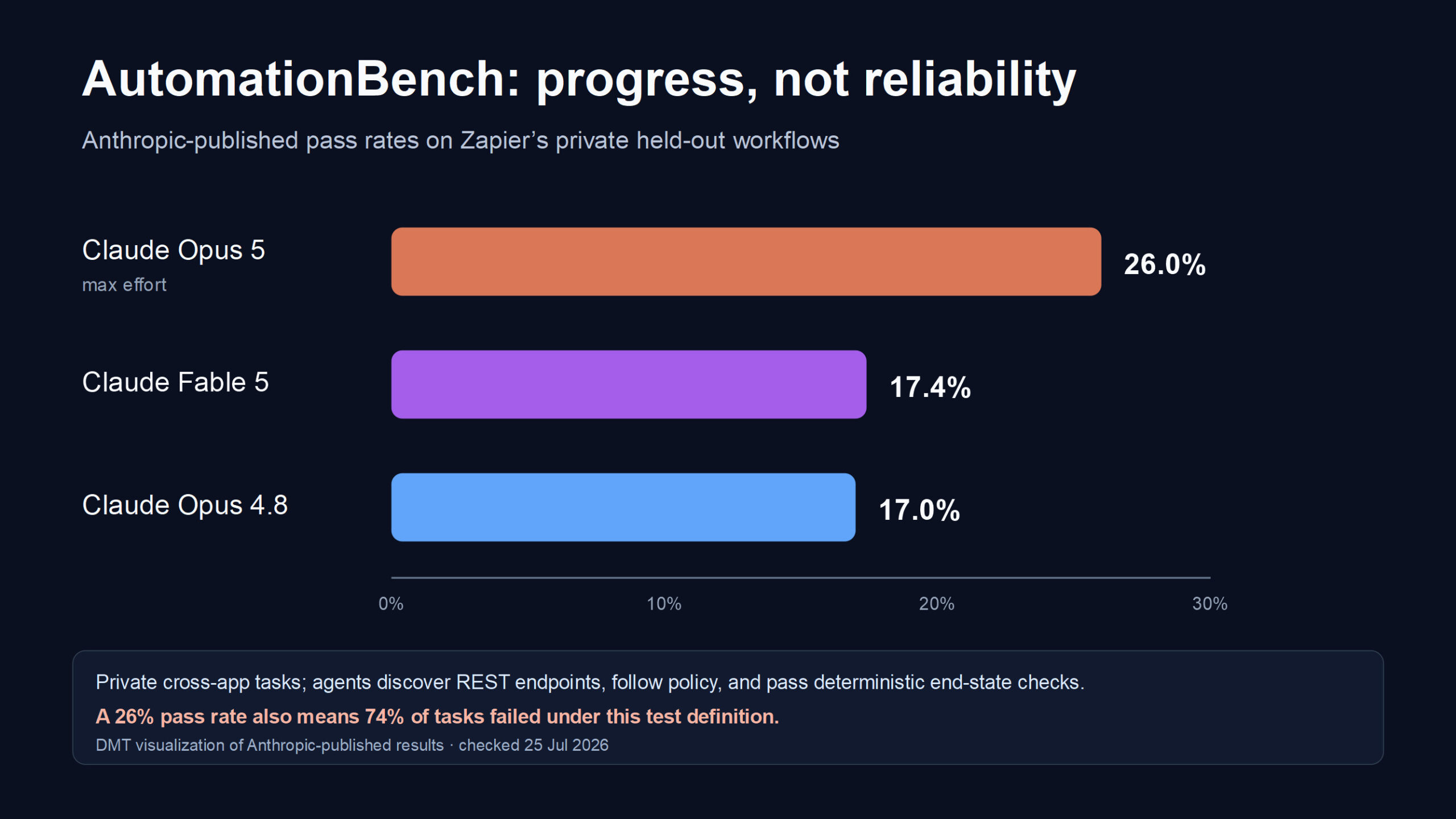
| AutomationBench | 26.0% at max; 24% at medium for $0.89/task | Zapier private held-out cross-app workflows with deterministic end-state checks | A leading 26% pass rate still means 74% of tasks failed under that test definition. |
The official FrontierBench chart makes Anthropic’s cost/performance argument visually clear, but the footnote is essential: five attempts, a named harness and backend, and a fallback model are part of the measured system. Until Anthropic confirms reusable press rights for the chart, the publication plan links to the official launch page and uses this accessible DMT table instead of copying the image. Benchmark charts are evidence about an evaluation system—not a promise that an unattended project will succeed.
What Opus 5 appears strongest at
- Difficult software work: multi-file features, debugging, code review and root-cause analysis where shallow fixes are expensive.
- Tool-heavy knowledge work: research, spreadsheets, documents and professional deliverables with observable acceptance checks.
- Computer use: bounded desktop workflows in environments that resemble the tested virtual-machine setup.
- Longer agent loops: planning, tool use, verification and delegation where the task can be paused or reviewed at checkpoints.
- Visual and interactive artifacts: Anthropic highlights frontend, chart, document and diagram work, including interactive launch examples.
These are realistic starting hypotheses, not production guarantees. A one-million-token window cannot ensure perfect recall. Self-verification cannot prove that an unsupported factual claim is true. A model that performs well over repeated benchmark attempts may still fail on the first run. Teams should measure accepted outcomes, retries, correction time and total cost on their own tasks.
Safety, guardrails and fallback behavior
Anthropic says Opus 5 produced the lowest overall misaligned-behavior score among its recent models in an automated audit and did not advance the frontier in the highest-risk biology or offensive cybersecurity capabilities. Those are Anthropic’s pre-deployment findings. The System Card should remain the source of record for what was tested and how.
Opus 5 has targeted cyber classifiers. Anthropic says they should intervene about 85% less often than Fable 5’s classifiers, while still blocking binary vulnerability scanning, penetration testing and exploit generation. In Claude.ai, Claude Code and Claude Cowork, flagged requests fall back to Opus 4.8 by default. API customers can enable fallbacks too. That means the model named at the start of a workflow may not complete every part of it; logs and evaluations should record fallback behavior.
Anthropic also states that important limitations remain on long-running autonomous biology research. That caveat belongs in the broader autonomy story: Opus 5 can sustain longer workflows, but the launch evidence does not establish a dependable autonomous employee. DMT’s agentic AI workflow framework explains why reversible stages and human approval points still matter.
Launch-day reaction: enthusiasm, cost anxiety and unfinished evidence
Public reaction on Reddit and X was broadly enthusiastic about coding quality and the possibility of using Opus as a daily model. The recurring counterpoints were subscription limits, the cost of long high-effort runs, skepticism about vendor charts and uncertainty about agents that operate for hours. These are anecdotal reports from early users, not controlled evaluations, and different accounts reported different levels of usage drawdown.
Matthew Berman’s July 24 edited review offers one durable practitioner lesson: compare cost per completed or accepted task, not token price alone. Most of the video interprets official or evaluator charts, so it is commentary rather than an independent benchmark. In his launch livestream, a Rubik’s Cube simulator attempt was still running after roughly nine minutes and 46,000 tokens, while stream-capture problems prevented a useful final inspection. It should not be treated as proof of success, speed or long-horizon reliability.
DMT also reviewed Matt Wolfe’s July 24 AI-news upload. It covers Kimi K3, GPT-5.6 Sol and other Anthropic news, but it does not discuss or test Opus 5. It is therefore excluded from this article’s Opus 5 evidence rather than being used because its publication date happened to match the launch.
What remains unknown after launch
- Independent replication: several evaluations were externally run, but many tasks are private or semi-private and some launch partners coordinated with Anthropic before release.
- Real subscription capacity: Anthropic does not publish one fixed message count that applies to every plan, task, context length and tool configuration.
- Very long autonomy: launch examples and benchmarks do not prove reliable multi-hour or multi-day unattended operation.
- Fast mode maturity: it remains a research preview, with partner-cloud availability and general-release timing unknown.
- Beta workflow stability: mid-conversation tool changes and automatic fallbacks need production monitoring before they become invisible infrastructure.
- Cost per accepted result: list price does not include retries, human correction, tool fees, cache behavior or the opportunity cost of waiting.
What the launch means in practice
Opus 5 makes the middle of Anthropic’s frontier lineup more interesting. It gives Pro and Max users a stronger everyday option and gives API teams a model with Fable-adjacent results on several difficult tasks without Fable’s base token price. It also makes routing more important: routine volume may still belong on Sonnet, while a small number of unusually hard cases may justify Fable.
Existing Opus 4.8 users should not perform a blind model-ID swap. Re-run token counting, expand output ceilings where necessary, test low through max effort, record fallbacks, and compare first-pass acceptance—not only a best-of-five result. Readers who need historical family context can use DMT’s earlier Opus guide; Claude Code users should also review the Claude Code Channels workflow guide before widening agent permissions.
Frequently asked questions
When did Claude Opus 5 launch?
Anthropic announced and released Claude Opus 5 on July 24, 2026.
How much does Claude Opus 5 cost?
The base Claude API price is $5 per million input tokens and $25 per million output tokens. Fast mode is $10/$50. Caching, batch, tools, regional routing, subscription plans and partner clouds can change the effective cost.
Is Opus 5 available in Claude Code and Cowork?
Yes. Anthropic’s launch documentation describes Opus 5 behavior and fallback handling in Claude.ai, Claude Code and Claude Cowork. Exact access and usable volume depend on the account, plan and usage conditions.
Does Opus 5 have a one-million-token context window?
Yes. Platform documentation lists one million input tokens as both the default and maximum context window, with up to 128,000 output tokens. That is capacity, not a guarantee of perfect recall.
Is Opus 5 better than every other model?
No universal ranking is supported. Opus 5 leads several launch evaluations, but it does not lead every coding row, and incompatible benchmark versions cannot be combined into one table. Choose using matched tasks, tools, effort, latency and acceptance criteria.
Can Opus 5 run autonomously for hours?
It is designed for longer agentic work, but launch evidence does not establish dependable unattended operation for arbitrary multi-hour tasks. Use checkpoints, budgets, tests and human approval for consequential actions.
Editorial note: This is a launch-news analysis based on Anthropic’s official announcement, current platform documentation and System Card, plus named external evaluators and clearly labelled practitioner reaction. DMT did not run an independent Opus 5 benchmark, and no benchmark chart is presented as a real-world guarantee.
About the author: Tayeeb Khan is a digital marketing strategist and SEO specialist who writes DMT’s evidence-led analysis of AI products, search platforms and practical workflows.