

Short answer: OpenAI says GPT-5.6 Luna is becoming the default model for ChatGPT Free and Go. Free and Go users get unlimited text chats with Luna, subject to abuse guardrails, plus a Think control for harder questions. “Unlimited text” does not mean every ChatGPT feature is unlimited: OpenAI explicitly says separate limits still apply to file uploads, image creation and other tools. This is a ChatGPT access change, not proof that Free or Go includes unlimited API use, Sol, Work or Codex.
This guide records the official position as of August 11, 2026. It is intentionally narrower than DMT’s GPT-5.6 model and prompting guide: the job here is to tell a Free or Go user what they can actually use, where limits remain and when Luna is sufficient.
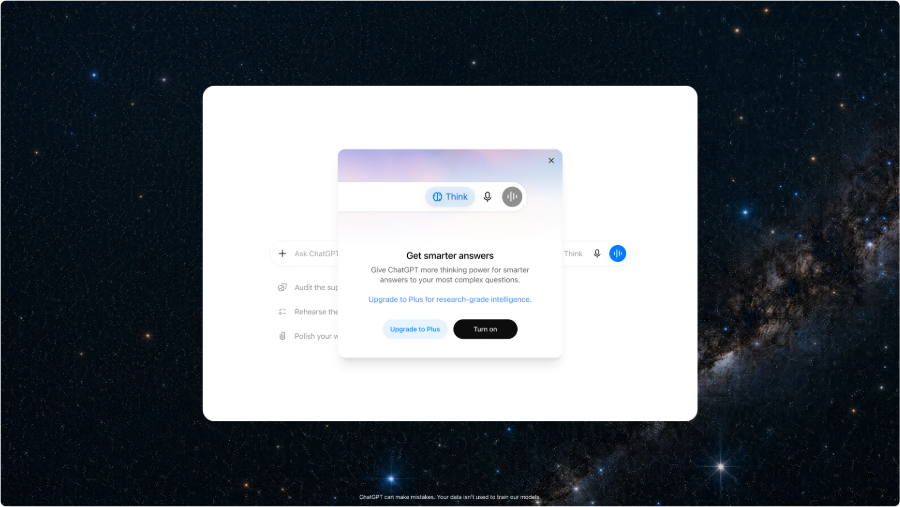
GPT-5.6 Luna Free and Go access at a glance
| Question | Official position as of August 11, 2026 | What it means in practice |
|---|---|---|
| Which model is the default? | GPT-5.6 Luna for ChatGPT Free and Go | Most ordinary new chats on those plans route to Luna without manual model selection |
| Are text chats capped? | OpenAI describes unlimited text chats, subject to abuse guardrails | Do not translate this into a contractual promise of unrestricted automation or abusive bulk use |
| Can Free and Go users ask for deeper reasoning? | Yes, through the Think control | Use it selectively for decisions, synthesis and multi-step reasoning; it is not needed for every rewrite |
| Are files, images and other tools unlimited? | No. Separate limits still apply | Large research jobs can stop because of a tool quota even if ordinary text remains available |
| Does this include API usage? | No such entitlement is established by the ChatGPT announcement | API usage is a separate product with separate billing, model IDs and limits |
| Does this replace Sol in Work or Codex? | No. OpenAI says the Sol change in ChatGPT does not alter Work/Codex Sol | Do not use this announcement to infer a model change in a different surface |
What OpenAI actually announced
OpenAI’s August 6 announcement makes four material claims for Free and Go users: Luna becomes the default, text chats are unlimited subject to abuse controls, a Think button is available for more difficult prompts, and non-text tools retain their own limits. Those claims need to stay together. Quoting only “unlimited” creates the wrong expectation; quoting only “limits apply” hides a meaningful access expansion.
The rollout wording is also time-sensitive. OpenAI said Luna would become the default for Free and Go during the announcement week, with unlimited text and Think starting the following week. If your account has not changed yet, that can be normal rollout variance rather than proof that the announcement is false. Check the current interface and official help text before troubleshooting.
The announcement’s scope is ChatGPT. The Luna API model page can explain API capabilities, but it does not prove what a ChatGPT plan includes. Likewise, the ChatGPT default does not create free API credits. Treat plan entitlement, API availability and model capability as three separate facts.
What “unlimited text chats” means—and what it does not
The safest interpretation is literal: ordinary text conversations with Luna are not governed by the earlier small message allowance described for that model, but access remains subject to abuse guardrails. The word does not erase service protections, account enforcement, regional availability, temporary capacity controls or separate feature quotas.
- Included in the statement: text prompts and text responses in normal ChatGPT use with Luna.
- Explicitly excluded from “unlimited”: file uploads, image generation and other tools with their own limits.
- Not established by the statement: unlimited API tokens, bulk unattended scraping, multiple-account workarounds or a guaranteed throughput level.
- Still policy-bound: use that triggers abuse systems can be restricted even when an ordinary text quota is not shown.
For marketers, the distinction usually appears during research. You may be able to continue asking Luna to outline, classify, rewrite and reason in text, yet be unable to upload another spreadsheet or create another image. Design a workflow that can continue from a compact text state rather than depending on repeated re-uploads.
How the Think control changes a Luna chat
Think is a user-facing request for more reasoning on a hard question. It is useful when the cost of a shallow answer is higher than the cost of waiting: choosing between campaign structures, reconciling conflicting evidence, diagnosing a measurement discrepancy, building a migration plan or checking constraints across a long brief.
| Task | Use normal Luna | Use Think |
|---|---|---|
| Rewrite five headlines in an established voice | Yes | Usually unnecessary |
| Summarize a short meeting note | Yes | Only if contradictions matter |
| Choose a primary keyword from GSC, GKP and current-owner evidence | For formatting the evidence | Yes for the decision and trade-offs |
| Diagnose why paid conversions fell after a landing-page change | For first-pass organization | Yes, after providing clean evidence and change dates |
| Generate 100 near-identical product descriptions | Possibly, with QA sampling | No; deeper reasoning adds little |
| Decide whether two pages cannibalise each other | For similarity cues | Yes; compare query, intent, reader job and information gain |
Think does not rescue a vague prompt. Give Luna the decision, evidence, hard constraints, acceptable assumptions and output format first. Then ask it to identify conflicts, show the decision rule and state uncertainty. The practical prompt pattern is:
Decision: [what must be decided]
Evidence: [facts, measurements, source links]
Constraints: [budget, deadline, policy, exclusions]
Required checks: [what could invalidate the answer]
Output: recommendation, rationale, risks, next test
Do not invent missing data; label assumptions.
Free vs Go: what can safely be compared
The Luna announcement confirms a shared default and unlimited text treatment for Free and Go. It does not, by itself, provide a complete plan comparison. Go can still differ from Free in pricing, non-text quotas, regional availability and other plan features. Because those details can change, do not copy an old quota table into a purchasing decision.
- Open your current plan page while signed into the account you will use.
- Check the exact file, image, browsing, memory, connector and workspace allowances shown for your region.
- Record the date and plan name if the allowance affects a client process.
- Test the intended workflow with non-sensitive data before relying on it.
- Choose Go for a documented plan benefit you need—not because “Luna” sounds different. Both plans share the Luna default described in the announcement.
The best Luna tasks for marketers
1. High-volume first-pass classification
Luna is well suited to organizing search queries, creative variants, support themes or research notes when the category rules are explicit. Give it a fixed taxonomy, examples near the decision boundary and an “uncertain” label. Sample-check every class before taking action.
2. Drafting from a verified brief
Use Luna to turn an approved outline and source ledger into first-pass sections. It should not invent the brief, choose sources and publish its own draft in one opaque step. Keep claims tied to source URLs and make a stronger reviewer own the final factual and editorial decision.
3. Structured QA
Ask Luna to find missing fields, broken constraints, inconsistent naming, unsupported claims and formatting errors. A checklist-style verifier is often a better use than an open-ended “make this better” instruction. For a deeper production model, see the Luna Max and Sol review workflow.
4. Routine analytics narration
Provide a clean metric table plus definitions and ask Luna to describe movements without claiming causation. It can identify what changed and which segments deserve investigation. A human or properly instrumented analysis must decide why it changed.
5. Scenario generation before a decision
Luna can generate plausible campaign, content or workflow scenarios quickly. Then use Think to compare them against the actual constraints. This two-stage pattern avoids spending deeper reasoning on ideas that are obviously infeasible.
When Luna is not enough
Move to a stronger model or a specialist workflow when the task has high factual risk, long-horizon tool use, substantial code changes, ambiguous evidence, legal/medical/financial consequences, or a costly irreversible action. Model escalation does not remove the need for human approval. It changes the probability and cost profile of the draft.
| Signal | Recommended action |
|---|---|
| The answer must reconcile many conflicting primary sources | Use Think or a stronger reasoning model; require citations and an uncertainty section |
| The workflow will edit production systems | Use least privilege, preview/diff, explicit approval and rollback |
| The task runs unattended for hours | Use a managed task/agent surface with budgets, receipts and stop conditions |
| The work is repetitive and objectively checkable | Luna can remain the worker; invest in deterministic validation |
| The output is subjective but cheap to revise | Use Luna for breadth, then human selection |
A safe Free/Go workflow
- Define the deliverable. Name the decision or artifact and what “done” means.
- Remove sensitive data. Do not paste client secrets, credentials or personal data simply because text chats are unlimited.
- Give sources and constraints. Separate verified facts from assumptions.
- Start in normal Luna. Ask for a structured first pass.
- Use Think only at the decision point. Ask it to resolve trade-offs, not to decorate the draft.
- Verify important claims. Open the primary source; do not treat a fluent answer as proof.
- Save durable state. Keep the approved brief, source URLs, final output and review decision outside a disposable chat when the work matters.
How to verify your own account
- Start a new ordinary chat and note the model/default label shown.
- Look for the Think control demonstrated in OpenAI’s official announcement.
- Run a harmless text prompt; then separately inspect file/image/tool availability.
- Open the current plan/usage screen for quota details rather than inferring them from the model name.
- If the rollout differs, check the announcement date, app version, account region and official status/help pages before contacting support.
Troubleshooting Luna access and limits
Luna is not shown as the default
First separate rollout timing from account state. Update the app, start a new chat, check the web product, and compare the current interface with OpenAI’s dated announcement. A conversation created before the rollout can retain a different state. Business/workspace policy can also differ from a personal Free or Go account; do not use a managed workspace as proof of the consumer plan.
Text still works but a file or image fails
This is consistent with the announcement because non-text tools have separate limits. Record which tool failed, the visible message and the time. Continue with a text-only summary of already extracted evidence if appropriate, or wait for the relevant allowance. Do not split a confidential file across accounts to evade a plan limit.
The answer is shallow even with Think
Check the input before blaming the model. A request such as “give me the best strategy” omits the decision, evidence, market, constraints and success metric. Ask Luna to list missing inputs, provide them, then require a recommendation plus counterarguments and disconfirming evidence. If the work remains high-stakes or source-heavy, escalate the reviewer/model instead of repeatedly regenerating.
Three practical workflow examples
Content brief from five official sources
Paste the source titles, URLs and verified notes as text. Ask normal Luna to group claims into product facts, implementation details, limits and unknowns. Use Think to decide the reader job, what existing DMT page owns adjacent intent and which information gain justifies a new URL. The deliverable is a brief and claim map—not a published article.
Search-query classification
Define mutually exclusive labels such as brand, problem, comparison, implementation and support. Include boundary examples, require an “uncertain” class and ask for a one-line reason. Run a sample, manually score it and revise the taxonomy before processing the full export. The unlimited-text claim does not remove the need to comply with data policy or avoid personal query data.
Weekly performance narration
Provide a table with current, prior and year-over-year metrics plus definitions. Ask Luna to report changes and data-quality warnings without claiming causes. Then use Think on two or three explicitly framed hypotheses. The final brief should separate observation (“non-brand clicks fell 18%”) from hypothesis (“ranking loss may be concentrated in two page groups”) and test (“compare query/page position and indexed state”).
FAQ
Is GPT-5.6 Luna free?
OpenAI says Luna is the default model for ChatGPT Free and Go and describes unlimited text chats subject to abuse guardrails. That does not mean the API is free or that every ChatGPT tool is unlimited.
Does ChatGPT Go get a better Luna model than Free?
The announcement identifies GPT-5.6 Luna as the default for both. It does not establish a separate “Go Luna” model. Compare current plan features and non-text allowances, not an invented model distinction.
Is Think the same as Sol?
No. Think is a control for requesting more reasoning in the current ChatGPT experience. The announcement does not say that pressing it changes the model to Sol.
Can I automate unlimited work with Free Luna?
No such entitlement follows from unlimited text chats. Unattended automation, API usage, tool quotas, rate limits and abuse protections are separate. Use the appropriate product surface and follow its current terms.
Bottom line
Luna’s Free/Go rollout is meaningful because it makes a capable default and an explicit deeper-reasoning control broadly accessible. The correct operating model is not “everything is unlimited.” It is: text access is broad, tools remain metered, Think is selective, API and Work/Codex are separate, and important outputs still need sources and review. For model selection beyond plan access, continue with DMT’s Sol, Terra and Luna guide; for economics, use the accepted-result methodology.
Related implementation paths: compare the current GPT-5.6 API price changes, build a governed recurring workflow with ChatGPT Work and Codex, or use DMT’s Luna marketing-automation cost controls.


