


Short answer: As of October 4, 2026, Gemini 4 Argon is rolling out to selected approved Fairwind cyber-defense partners. Google plans to expand access to paid API customers and Google AI Ultra subscribers, but has not given a date. Its announcement lists introductory token prices of $2 per million input tokens and $10 per million output tokens.
Who can use Gemini 4 Argon now?
Google’s Fairwind Program prioritizes governments and national cyber authorities; critical-infrastructure operators in healthcare, telecommunications, energy and financial networks; and core technology platforms. The FAQ also welcomes academic labs focused on defensive benchmarking. For students, it recommends CodeMender on Google Cloud; that is not a promise of student access to Argon.
Google vets applicants for an ethical operations and research record. Approved partners may grant access only to internal cybersecurity, incident-response or penetration-testing teams; they cannot share, redistribute or sell Argon access. The application page gives no review deadline or acceptance guarantee. On October 4, Argon was absent from the public Gemini API model catalog and release notes, so those pages did not yet document a generally available endpoint.
The Fairwind FAQ makes one narrow data-retention statement: zero data retention is supported when Argon is accessed directly as a managed model on Gemini Enterprise. It does not say that every future API or product route inherits the same arrangement. Confirm the terms for the exact surface and account you plan to use.
What Google has announced about price and capacity
The September 30 announcement gives token prices in US dollars per million. It sets an introductory input and output rate and says higher rates apply after the introductory period. Google’s current public pricing table did not list Argon when checked; these are announced token prices, not confirmation of live public API billing.
| Stage | Input | Output | Cached input | Timing |
|---|---|---|---|---|
| Introductory | $2 | $10 | $0.10* | End date not announced |
| After introductory period | $4 | $20 | Not stated | Effective date not announced |
*Google says cached input is 95% off the introductory $2 input rate; $0.10 per million is the arithmetic result. The announcement does not say whether that discount continues after the introductory period. Do not carry it forward as a later rate.
For scale, 100,000 uncached input tokens plus 10,000 output tokens works out to about $0.30 at introductory rates ($0.20 + $0.10) or $0.60 at the announced later rates ($0.40 + $0.20). One million output tokens alone would total $10 introductory or $20 later at those rates, but the maximum output capacity is not a workload target. This is token arithmetic, not an invoice estimate; it excludes cache use, tools, other charges and account-specific terms.
Google’s announcement says Argon can generate up to 1 million output tokens in one trajectory. It does not state a matching 1 million-token input window. The public model catalog had no Argon entry on October 4, so Google’s announced output capacity should not be used as an input-context specification.
If you are comparing announced Gemini rates with a model you can use now, keep the model and product surface separate. Our Gemini 3.8 Flash API pricing and migration guide covers that distinct model’s documented API terms; its rates and capabilities do not transfer to Argon.
What the benchmark evidence does and does not show
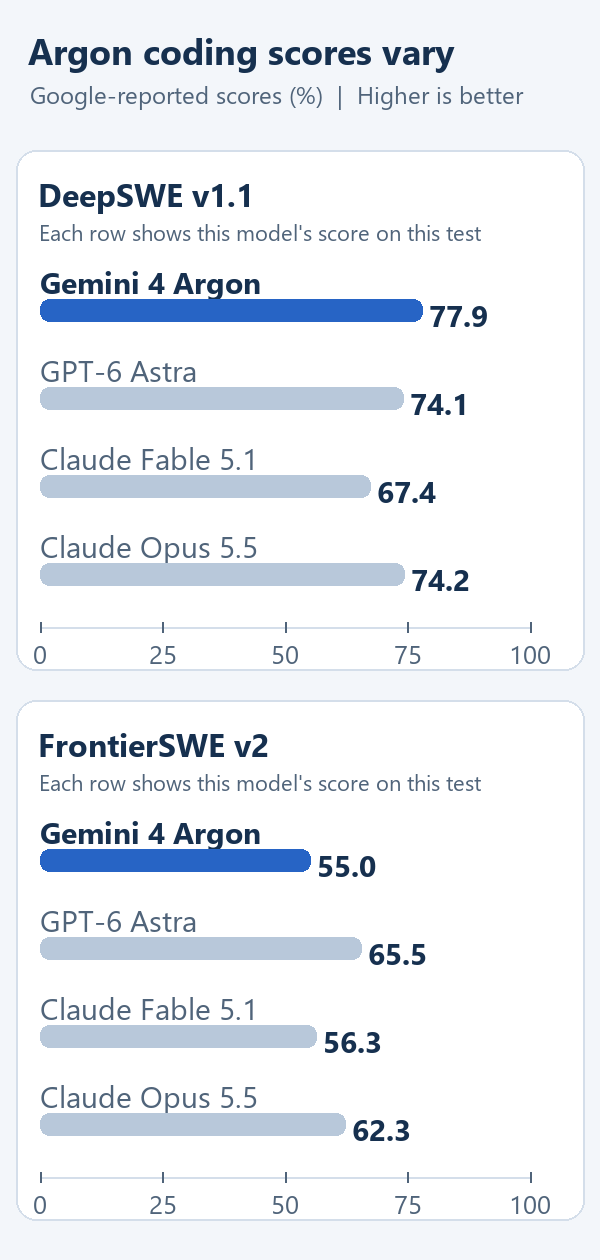
Google’s reported results vary by test. In DeepSWE v1.1, Argon scores 77.9%, ahead of the other three models shown. In FrontierSWE v2, it scores 55.0%, below each of those three. The vendor table therefore does not establish a universal coding lead.
| Benchmark | Gemini 4 Argon | GPT-6 Astra | Claude Fable 5.1 | Claude Opus 5.5 |
|---|---|---|---|---|
| DeepSWE v1.1 | 77.9 | 74.1 | 67.4 | 74.2 |
| FrontierSWE v2 | 55.0 | 65.5 | 56.3 | 62.3 |
As Google’s methodology explains, Argon’s scores are pass@1 unless noted and use its highest Gemini API thinking setting unless noted. Competitor figures generally come from provider-reported results at maximum reasoning effort or the best available setting. Google says Argon’s DeepSWE result used its mini-swe harness, while comparator results came from a leaderboard or system cards; FrontierSWE figures came from Proximal’s public leaderboard. Treat them as reported comparisons, not a uniform four-model run.
Vals AI’s current Argon model page, captured here on October 4, lists 68.90% ±0.97 on the Vals Index (rank 1 of 43 models), 65.40% ±0.32 on Finance Agent v2 (1 of 74), 57.58% ±2.31 on Terminal-Bench 4.0 (5 of 43), and 19.58% ±3.31 on Harvey’s Legal Agent benchmark (5 of 74). The rank denominators count models in Vals’ current listings, not task samples, and ranks can move. Vals reports standard errors, not real-world confidence bounds. Its methodology says Finance Agent v2 and Terminal-Bench use three runs and defines the displayed uncertainty as standard error. The Vals Index page explains that its GDP-weighted benchmark score is a capability proxy, not return on investment.
Vals lists Google as its default provider, temperature 1, high reasoning and a maximum output setting of 262,144 tokens, while warning that some benchmarks use different providers or parameters. That maximum is Vals evaluation metadata, not Google’s product limit or a public endpoint guarantee. Vals’ pricing metadata shows $4/$20 per million, which does not override Google’s announced $2/$10 introductory prices or prove that public billing is live. Vals reports 57.58% on Terminal-Bench 4.0; Google’s separate table lists 57.4%. These are different evaluations, not a combined result. Google cites Vals lineage for its Index and Finance results, so Vals is not an independent replication of Google’s multi-model table.
A practical way to plan around Argon
For a purchase or integration decision, wait for Google to document the model ID, input limit, price schedule and account availability, then compare Argon on your own tasks against your own acceptance criteria. The published scores can help choose test cases, but they do not predict your workflow’s results.
Disclosure: This article was prepared with AI assistance. Availability, pricing and evaluation claims were checked against the linked public sources on October 4, 2026. No Argon account or API test was performed.