
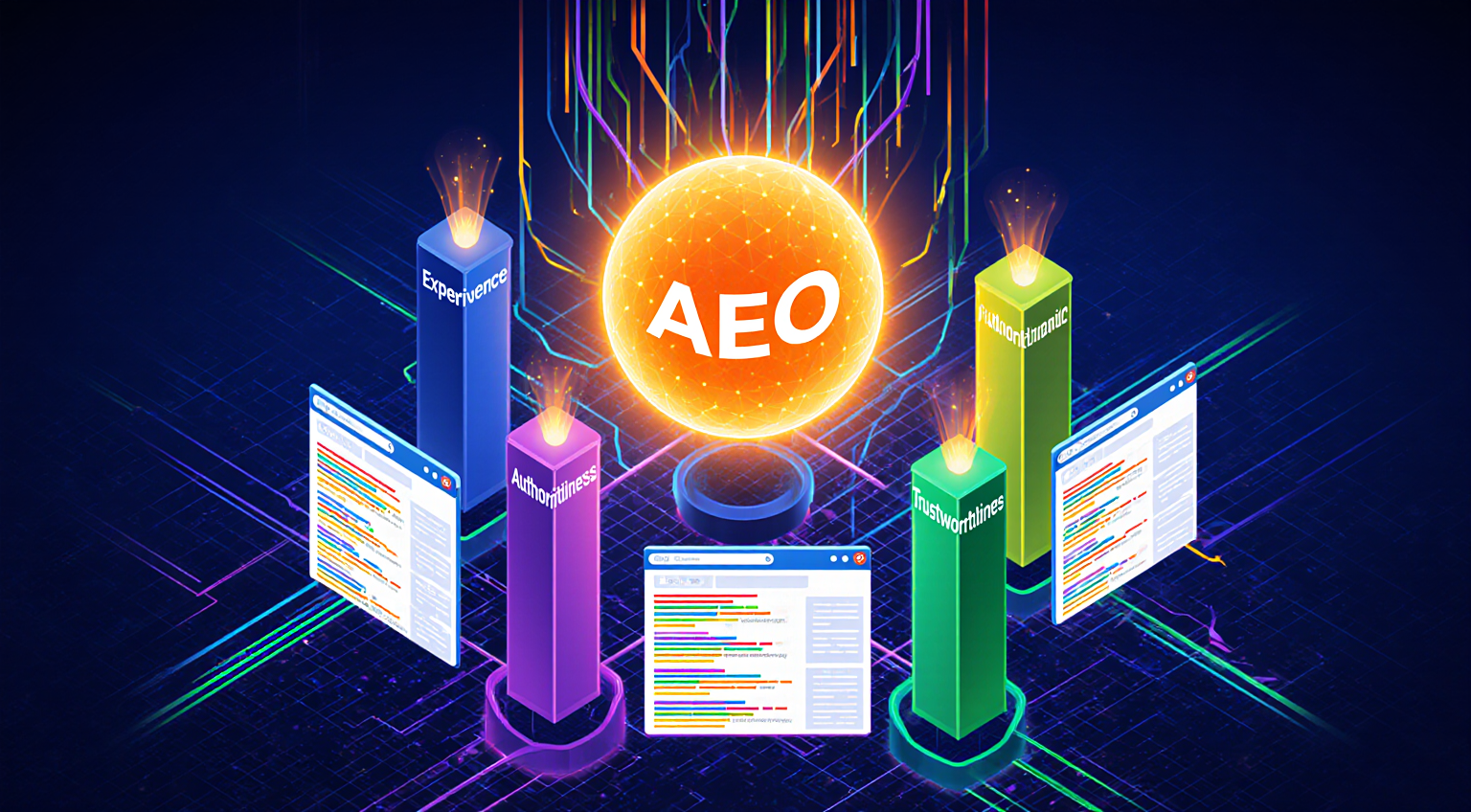
The digital content landscape is undergoing a profound transformation. In 2025, while traditional Search Engine Optimization (SEO) remains vital, the era of Answer Engine Optimization (AEO) has firmly arrived. This isn’t merely about driving traffic; it’s about optimizing your content to be the definitive, trusted answer presented by AI-powered search experiences. Central to this evolution are Google’s robust E-E-A-T (Experience, Expertise, Authoritativeness, Trustworthiness) principles, which are now more critical than ever for securing prime visibility on the Search Engine Results Page (SERP).
E-E-A-T as Your AEO North Star for SERP Dominance
AEO represents the critical next step in SEO. As user behavior pivots towards direct answers, often bypassing traditional link-based results, establishing robust E-E-A-T signals becomes non-negotiable for content visibility. Current data reveals that approximately 60% of Google searches result in zero clicks, meaning users frequently find their answers directly on the SERP within AI-generated responses, featured snippets, or knowledge panels. This “zero-click reality” profoundly underscores why your content must demonstrate unparalleled authority and trustworthiness to be selected and prominently displayed as the definitive answer by search algorithms. E-E-A-T signals directly influence Google’s understanding of content quality, thereby impacting its algorithmic ranking decisions for high-visibility SERP features.
Understanding the AEO Landscape and its Impact on SERP in 2025
Answer Engine Optimization fundamentally redefines how we approach content strategy. Unlike traditional SEO, which primarily aims for top rankings in organic search results, AEO focuses on optimizing content to be directly featured as answers. This includes platforms like ChatGPT, Perplexity AI, Google’s rich snippets, AI Overviews, and voice search results. In this environment, where the direct answer is paramount, only the most authoritative and trustworthy content makes the cut for these highly visible SERP positions.
The Zero-Click Reality: Your Content Must Be the Definitive Answer
The rise of answer engines has ushered in an era of instant gratification for users. They receive immediate, concise answers without needing to click through to a website. This significant shift amplifies the importance of E-E-A-T. Search engines and advanced AI models must discern which of millions of potential sources provides the most reliable and accurate information. For a deeper dive into current search trends and the evolving role of content, explore our analysis on the evolution of search engine optimization. Your content’s ability to demonstrate E-E-A-T directly informs its likelihood of being chosen for these high-value, zero-click answer boxes on the SERP.
The Four Pillars of E-E-A-T for AEO and SERP Ranking Success
E-E-A-T is no longer an abstract guideline; it’s an actionable framework that directly informs Google’s algorithms about the quality and reliability of your content, thereby influencing its ranking potential. Let’s break down each pillar and how to strategically implement it for optimal AEO performance and improved SERP visibility.
1. Experience: The Foundation of First-Hand Knowledge
Experience represents the most tangible aspect of E-E-A-T. It demands that content creators demonstrate genuine, first-hand knowledge and practical application of their subject matter. For AEO, this translates into content that clearly showcases real-world application, personal insights, and tangible results, proving that you’ve been there, done that. Content imbued with genuine experience resonates more deeply with users and signals higher quality to AI systems, making it more likely to be selected for prominent SERP features.
Implementing Experience Signals for Enhanced Ranking:
- Document actual processes with step-by-step photography or screenshots: Visual evidence of practical application significantly boosts perceived experience.
- Include personal anecdotes and case studies from real scenarios: Share your journey, challenges, and successes to establish genuine connection and practical understanding.
- Feature customer testimonials with verified outcomes: Social proof from real users who have benefited from your experience adds powerful credibility.
- Showcase before-and-after results from actual implementations: Tangible demonstrations of your work’s impact build strong trust and authority.
- Incorporate original research data and findings: Present unique data derived from your direct involvement or observations within the field.
2. Expertise: Demonstrating Deep, Actionable Knowledge
Expertise goes beyond surface-level understanding; it requires content that displays comprehensive, in-depth knowledge within a specific domain. For AEO, this means creating content that AI engines can confidently cite as authoritative, proving you know your stuff inside and out. Content that showcases nuanced understanding and technical accuracy is favored by algorithms for complex queries and “Your Money Your Life” (YMYL) topics.
Building Expertise Indicators for Algorithm Recognition:
- Prominently display author credentials and professional qualifications: Clearly state the background and training of content creators (e.g., certifications, degrees, years in industry).
- Ensure technical accuracy verified through multiple expert sources: Cross-reference information to eliminate errors and reinforce factual correctness.
- Explain complex concepts with appropriate depth and nuance: Break down difficult ideas into understandable segments without oversimplifying or omitting critical details.
- Integrate industry-specific terminology and methodologies correctly: Use the language of your field precisely to demonstrate authentic knowledge.
- Reference peer-reviewed research and authoritative publications: Ground your content in established academic or industry-leading sources to bolster its credibility.
3. Authoritativeness: Establishing Industry Recognition and Reputation
Authoritativeness extends beyond individual expertise to encompass recognition within the broader industry ecosystem. This collective recognition signals to AI engines that your content source is widely accepted as a credible leader or go-to resource in its field, showing that others know you know your stuff. A strong authoritative presence influences how algorithms view your site’s overall trustworthiness and relevance.
Developing Authority Markers for Increased SERP Impact:
- Create professional author biographies with verifiable credentials: Provide detailed bios for all content creators, linking to their professional profiles (LinkedIn, academic pages, etc.).
- Highlight speaking engagements and conference presentations: Participation in industry events demonstrates thought leadership and recognition.
- Feature media mentions and industry publication features: Being cited or published by reputable industry outlets significantly boosts authority.
- List professional associations and certifications: Affiliations with recognized bodies add layers of credibility.
- Showcase awards and recognition from industry peers: External validation through awards or peer recognition is a powerful authority signal.
4. Trustworthiness: The Central Pillar of SERP Reliability
Google explicitly identifies trustworthiness as the most critical component of E-E-A-T, stating that “untrustworthy pages have low E-E-A-T no matter how Experienced, Expert, or Authoritative they may seem.” For AEO, trustworthiness encompasses both technical reliability of your website and the absolute accuracy and transparency of your content. This pillar proves to both users and algorithms that they can rely on you. A lack of trust can severely hamper your ability to rank, especially for YMYL topics.
Implementing Trust Signals for Algorithmic Confidence:
- Provide transparent author attribution with complete professional profiles: Make it easy for users and crawlers to identify who created the content and their background.
- Ensure regular content updates with clearly marked revision dates: Demonstrate that your information is current and maintained.
- Conduct rigorous fact-checking with credible source citations: Back up all claims with reputable external links or verifiable data.
- Disclose affiliations and potential conflicts of interest: Maintain transparency regarding any relationships that might influence your content.
- Maintain secure website infrastructure with proper SSL certificates (HTTPS): A secure site is a fundamental trust signal for users and search engines.
- Clearly display contact information, privacy policies, and terms of service: Essential for building user confidence and demonstrating accountability.
Strategic Content Architecture for AEO and Optimized SERP Performance
Building content authority requires more than just individual pieces; it demands a cohesive, interconnected strategy that algorithms can easily understand and prioritize.
The Hub-and-Spoke Content Model: Building Topical Authority
The most effective approach for building comprehensive topical authority in AEO involves creating interconnected content ecosystems using the hub-and-spoke methodology. This structure clearly demonstrates deep expertise across interconnected topics while maintaining clear hierarchical relationships, signaling to algorithms the breadth and depth of your coverage.
- Hub Page Strategy:
- Create comprehensive pillar content targeting high-volume, competitive keywords that serve as central resources.
- Provide broad topic overviews with strategic, contextual links to specialized subtopics.
- Aim for 3,000-5,000 word comprehensive guides that act as authority anchors for a given subject.
- Update these hub pages regularly with fresh insights and expanded coverage to maintain relevance and E-E-A-T.
- Spoke Content Development:
- Target long-tail, question-based queries that directly support and elaborate on aspects of the main hub topic.
- Create 1,500-2,500 word detailed explorations of specific subtopics, answering user queries thoroughly.
- Structure content to answer specific user questions directly and concisely, ideal for featured snippets and AI Overviews.
- Implement FAQPage schemas and question-answer formats within these spokes to enhance their discoverability for answer engines.
Internal Linking Architecture: The Connective Tissue for SERP Visibility
Strategic internal linking serves as the connective tissue that transforms individual content pieces into authoritative knowledge networks. This well-planned architecture helps both users and AI engines understand content relationships, topical depth, and the overall authority of your domain. It guides crawlers through your site, distributing “link equity” and reinforcing your expertise to algorithms. For a step-by-step guide to developing this crucial element, see our post on building content expertise.
Linking Best Practices for AEO and SERP Impact:
- Implement bidirectional linking between hub and spoke content: Ensure relevant spokes link back to their parent hub, and hubs link out to their spokes.
- Use descriptive and keyword-rich anchor text: Avoid generic “click here” text; instead, use phrases that accurately describe the linked content and include relevant keywords.
- Maintain logical content progression through strategic link placement: Links should naturally guide the user (and crawler) through related topics.
- Create tightly knit topic clusters with 5-10 closely related pieces of content: This strong internal linking within clusters signals deep topical authority.
- Monitor and update internal links regularly as content expands: Ensure all links are relevant and unbroken.
Technical Implementation for AEO Success and Enhanced SERP Presence
Even the most well-researched and expertly written content needs proper technical foundations to be discoverable, interpretable, and prioritized by AI-powered search engines.
Schema Markup and Structured Data: Speaking the Language of AI
Structured data implementation serves as the critical bridge between human-readable content and machine-interpretable information. For AEO, this markup dramatically increases the likelihood of your content being selected by AI engines for rich results, featured snippets, and AI Overviews on the SERP. Learn more about its strategic application in our guide to schema markup implementation for content authority.
Essential Schema Types for AEO and SERP Features:
- FAQPage Schema: Crucial for question-answer content formats, directly fueling featured snippets and “People Also Ask” sections.
- HowTo Schema: Ideal for step-by-step instructional content, leading to richer step-by-step results on the SERP.
- Article Schema: For comprehensive blog posts and guides, helping search engines understand the content’s type and main entities.
- Person Schema: For author credibility and expertise signals, linking content to verifiable individual authors and their authority.
- Organization Schema: For business authority and trust signals, clarifying the entity behind the content and its official standing.
Content Structure Optimization: Algorithmic Readability
AI engines and ranking algorithms heavily favor content with clear hierarchical structure and logical information flow. This optimal organization enables efficient content extraction and presentation in various answer formats on the SERP, from concise snippets to comprehensive AI Overviews.
Key Structural Elements for Algorithmic Favorability:
- Clear H2/H3 headings that pose and answer specific questions: This makes your content easily scannable for both users and AI, directly addressing potential queries.
- Concise answer paragraphs of 40-60 words for snippet optimization: Craft direct, succinct answers to common questions to maximize your chances of appearing in featured snippets.
- Numbered lists and bullet points for easy information extraction: These formats are highly digestible for users and easily parsed by algorithms for list-based answers.
- Table formats for comparative data and specifications: Presenting data in tables allows for quick comparison and structured extraction by AI.
- Summary boxes highlighting key takeaways: Placing brief summaries at the beginning or end of sections provides quick answers and reinforces main points.
Voice Search and Conversational Optimization: Adapting to New Query Patterns
Voice search queries typically use natural language patterns that differ significantly from traditional typed searches. Optimizing for these conversational queries is crucial for AEO, as voice assistants often pull answers directly from featured snippets or AI Overviews. Dive deeper into this area with our guide to voice search optimization in the age of AI.
Voice-Friendly Content Features:
- Natural language question formats as headings: Mirror how users ask questions verbally.
- Conversational tone matching spoken query patterns: Write as if you’re speaking directly to the user.
- Local optimization for “near me” and location-based queries: Crucial for businesses targeting local voice searches.
- Featured snippet targeting with direct, concise answers: Voice assistants often rely on these.
- Mobile-first design ensuring fast loading on voice-enabled devices: Speed is paramount for positive user experience and algorithmic favorability.
Building Content Authority Through Expert Integration and SERP Signaling
Leveraging external authority significantly enhances your E-E-A-T signals, providing unique insights that AI engines highly value for answer generation and content prioritization on the SERP.
Expert Interview Strategy: Infusing Third-Party E-E-A-T
Incorporating expert voices within your content not only provides invaluable insights but also significantly enhances E-E-A-T signals. This approach leverages external authority to strengthen your content’s credibility, making it more appealing to both users and algorithms looking for high-quality, trustworthy information. Check out our detailed guide on expert interview strategies for digital marketers.
Expert Integration Methods:
- In-Depth Interviews: Conduct 30-45 minute recorded conversations exploring specific topics, yielding rich, unique content.
- Quote Integration: Seek expert opinions on specific questions via email, allowing for precise integration of their insights.
- Guest Contributions: Invite recognized experts to contribute sections or entire articles, bringing their established authority directly to your platform.
- Panel Discussions: Host multi-expert perspectives on complex topics, demonstrating a comprehensive understanding of the subject.
- Case Study Collaboration: Work with experts to document real-world applications and outcomes, providing concrete evidence of expertise.
Expert Selection Criteria:
- Verifiable credentials and professional standing: Ensure the expert’s background is legitimate and impressive.
- Active industry participation and recognition: Look for individuals who are actively contributing to and recognized within their field.
- Complementary expertise that enhances content depth: Choose experts whose knowledge fills gaps or adds unique perspectives to your content.
- Willingness to provide quotable insights and data: Ensure they can articulate their knowledge in a way that benefits your content.
- Professional network that can amplify content reach: Experts often have a platform through which your content can gain further exposure.
Content Distribution and Amplification for Maximize SERP Exposure
Strategic content distribution ensures maximum visibility across platforms where AI engines source information. This multi-channel approach increases the likelihood of your content being discovered, cited, and ultimately favored for prominent SERP positions.
Effective Distribution Channels:
- Industry Publications: Pursue guest posting opportunities on authoritative trade publications, leveraging their established authority.
- Professional Networks: Actively share content on LinkedIn articles, industry-specific groups, and other professional communities.
- Video Platforms: Create supplementary YouTube content (e.g., video summaries, interviews) for multimedia authority signals and broader reach.
- Podcast Networks: Distribute audio content for voice-search optimization and to engage a different audience segment.
- Community Forums: Engage directly on platforms like Reddit, Quora, and industry-specific forums, establishing your brand as a helpful, expert resource.
Measuring AEO Performance and E-E-A-T Impact on SERP
Measuring AEO success requires tracking metrics that reflect both search visibility and authority recognition, directly linking your efforts to your SERP performance. These indicators provide crucial insight into how your content is performing across AI-powered platforms and its E-E-A-T strength. Our post on measuring content authority offers a comprehensive overview of relevant KPIs.
Key Performance Indicators (KPIs) for AEO and SERP Analysis
Primary Metrics:
- Featured Snippet Capture Rate: Track the percentage of your target keywords that achieve “position zero” on the SERP.
- Voice Search Visibility: Monitor how frequently your content is cited or used as a direct answer for voice queries.
- AI Platform Citations: Actively track mentions and direct usage of your content by large language models like ChatGPT, Perplexity, and Google’s AI Overviews.
- Brand Mention Frequency: Track unlinked and linked brand references across the web, indicating broader industry recognition.
- Expert Network Growth: Measure the expansion of your professional relationships and collaborations, signaling growing authority.
Secondary Indicators:
- Engagement Depth: Analyze time on page and content completion rates to understand user satisfaction and content quality.
- Expert Endorsement: Monitor social shares, backlinks from authoritative sources, and professional recommendations for your content.
- Content Freshness Score: Track the frequency and impact of your content updates and maintenance efforts.
- Technical Authority Score: Assess your site’s adherence to schema implementation and structural optimization levels.
Future-Proofing E-E-A-T for AEO: Adapting to Evolving SERPs
The intersection of E-E-A-T and AEO is not static; it continues to evolve rapidly as AI technologies advance and Google refines its ranking algorithms. Staying ahead requires a proactive understanding of emerging patterns and agile adaptation of your content strategies. This also applies to our cross-domain strategy, especially when connecting AEO and GEO E-E-A-T principles. Read our comparison content highlighting similarities and differences between AEO and GEO E-E-A-T.
Emerging Trends and Adaptations to Consider:
- Multimodal AI Integration: Optimizing for recognition and relevance across image, video, and audio content, not just text.
- Real-Time Fact Checking: AI engines are increasingly verifying claims against multiple, diverse sources in real-time, demanding impeccable accuracy.
- Personalized Authority Signals: Expect AI adaptation based on individual user preferences, search history, and behavioral patterns.
- Cross-Platform Consistency: Ensure unified E-E-A-T signals across all your digital touchpoints, from your website to social media and external mentions.
- Dynamic Content Updates: The ability to make real-time content modifications based on direct AI feedback or evolving information.
Strategic Recommendations for Sustained SERP Success:
Immediate Actions:
- Conduct a comprehensive E-E-A-T audit of your existing content to identify strengths and weaknesses.
- Prioritize and implement structured data markup (Schema.org) across all key pages that target answer engine results.
- Develop a clear expert interview calendar with monthly or quarterly publications to infuse fresh, external E-E-A-T.
- Begin restructuring your primary topics using the hub-and-spoke content architecture.
- Establish a consistent content update and maintenance schedule to ensure freshness and accuracy.
Long-Term Initiatives:
- Actively build industry recognition through regular speaking engagements, conference presentations, and contributions to leading industry publications.
- Invest in developing original research capabilities to generate unique data insights, positioning yourself as a primary source.
- Create comprehensive measurement and optimization frameworks to continuously refine your AEO and E-E-A-T strategies.
- Establish strategic partnerships with complementary industry experts and organizations for collaborative content and cross-promotion.
- Invest in robust technical infrastructure that supports advanced schema implementation and rapid content delivery.
Conclusion: The Future of Content is E-E-A-T Driven
The convergence of E-E-A-T principles and Answer Engine Optimization is not just a passing trend; it represents the definitive future of content strategy in an AI-driven search landscape. Organizations that successfully integrate these approaches will not only dominate answer engine visibility but also build sustainable competitive advantages through genuine expertise and unwavering authority. The key lies in understanding that E-E-A-T is not merely a ranking factor to manipulate but a comprehensive, holistic approach to content creation that prioritizes user value, authentic expertise, and unquestionable trustworthiness over superficial tactics.
Success in this dynamic environment demands a profound commitment to continuous learning, proactive expert relationship building, and technical excellence. The investment in E-E-A-T-focused AEO strategies pays dividends not only in enhanced search visibility and improved SERP positions but, more importantly, in building genuine brand authority and fostering deep customer trust that will transcend ephemeral algorithm changes and platform shifts.
As answer engines continue to evolve at an unprecedented pace, content creators who establish strong E-E-A-T foundations today will be exceptionally well-positioned to adapt, innovate, and thrive regardless of future technological developments. The future belongs to those who master the art of combining authentic expertise with strategic optimization, consistently creating content that serves both human needs and AI requirements with equal excellence.
